Title
Untitled
1993
Artist
-
Details
- Place where the work was made
-
Alice Springs
→
Northern Territory
→
Australia
- Date
- 1993
- Media category
- Painting
- Materials used
- synthetic polymer paint on paper on canvas
- Dimensions
- 76.5 x 58.0 x 3.3 cm stretcher
- Signature & date
Not signed. Not dated.
- Credit
- Mollie Gowing Acquisition fund for Contemporary Aboriginal art 1993
- Location
- Not on display
- Accession number
- 312.1993
- Copyright
- © Estate of Robert Ambrose Cole. Reproduced with permission of Utopia Art Sydney
- Artist information
-
 Robert Ambrose Cole
Works in the collection
- Share
-


-
About
'I was born in Alice Springs. I paint my mother's and my father's country. My mother's country is Banka Banka, Warramunga people, north of Tennant Creek. Most of my paintings are from around Aputula, Finke, my father's country. His country is south of Alice Springs, the sand hills on the edge of the Simpson Desert ... My images come from all over the place.'
Robert Ambrose Cole was a self-taught artist who lived and worked in Mparntwe (Alice Springs). Cole's style of painting was influenced by his years growing up in an urban centre, exposed to the art movements of the Central and Western Deserts. He experimented with both acrylic dot painting and the European-influenced landscapes of the Hermannsburg watercolourists, whose proponents included Albert Namatjira and Otto Pareroultja. While Cole maintained both forms of practice, their synthesis led to his shimmering white dot paintings, in which figures and shapes emerge. These works combine a translucency and subtlety, influenced by the watercolours, with Cole's obvious stylistic affinity with dot painting.
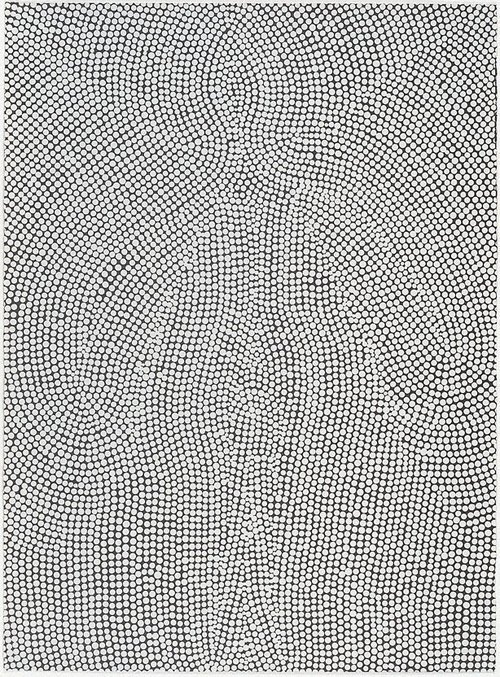
Cole often emulated natural ochres with acrylic colours. In 'Untitled', 313.1993, through careful placement and very subtle variations in the size of the dots, he builds up a pattern of square forms that appear within the field. This work's intensity is similar to op art, as the viewer tries to define the grid-like shapes that emerge and retreat into the oscillating white field painted over an ochre-brown background. The tracks of lines of dots that create the grid give an almost maplike appearance to the work as the eye charts a path across its surface. At the same time, the painting remains resolutely abstract and is not connected to a particular story and place.
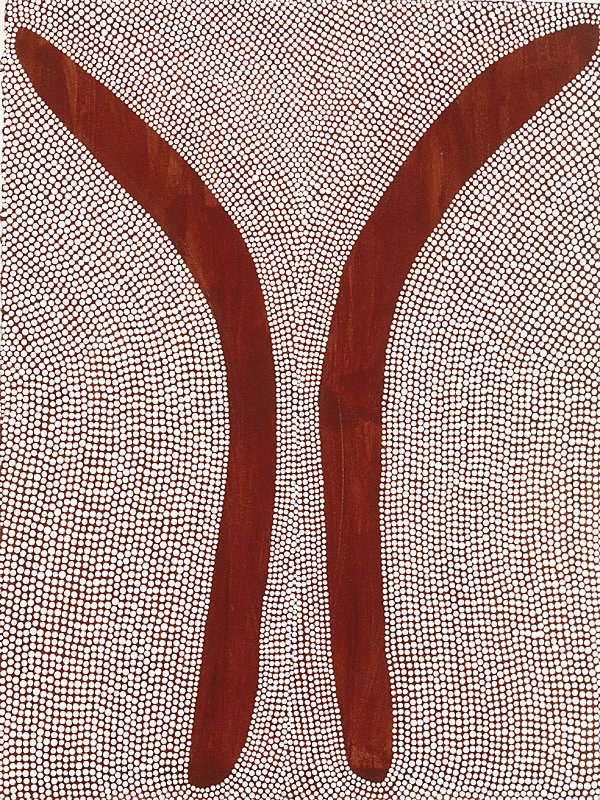
In 'Untitled', 312.1993, Cote painted dots in lines that curve across the paper, defining two forms from the ochre background. These two shapes have been described in many ways: as deriving from ceremonial body markings; as suggesting the dramatic gorges that cut through rock formations in the desert near Mparntwe; or as recalling the shapes of hunting boomerangs. While these may all be possible sources or references in this work, the brown shapes are also abstract, grounded in both traditional Aboriginal culture and a very contemporary painterly experimentation with colour and form.
Wayne Tunnicliffe in 'Tradition today: Indigenous art in Australia', Art Gallery of New South Wales, Sydney, 2004
© Art Gallery of New South Wales
-
Places
Where the work was made
Alice Springs
-
Exhibition history
Shown in 4 exhibitions
Australian Perspecta 1993, Art Gallery of New South Wales, Sydney, 06 Oct 1993–28 Nov 1993
Gamarada, Art Gallery of New South Wales, Sydney, 15 Nov 1996–16 Feb 1997
Another Country, Art Gallery of New South Wales, Sydney, 04 Jul 1999–02 Apr 2000
Robert Cole, Utopia Art Sydney Pty Ltd, Alexandria
-
Bibliography
Referenced in 5 publications
-
Deborah Edwards, One sun one moon: Aboriginal art in Australia, ‘Histories in the making: Aboriginal Art and modernism’, pg. 51-63, Sydney, 2007, 56 (colour illus.).
-
Christopher Hodges, The Oxford companion to Aboriginal art and culture, 'Cole, Robert Ambrose', pg. 561-562, South Melbourne, 2000, 562 (illus.). illus.no. 308
-
Victoria Lynn (Editor), Australian Perspecta 1993, Sydney, 1993, 22.
-
Margo Neale, Yiribana: Aboriginal and Torres Strait Islander collection, Sydney, 1994, 110, 111 (colour illus.), 136, 139. plate no .53
-
Wayne Tunnicliffe, Tradition today: Indigenous art in Australia, 'Robert Ambrose Cole', pg. 40, Sydney, 2004, 40 (colour illus.).
-