Title
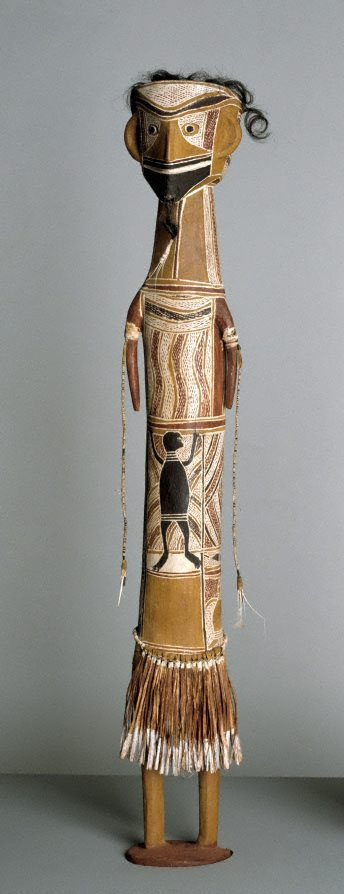
Figure of Djan'kawu, ancestral being of the Dhuwa moiety
collected 1960
Artist
-
Details
- Other Titles
- Figure of an Ancestral Being, of the Dhuwa Moiety
Figure of Djan'kawu, Ancestral Being of the Dhuwa moiety - Place where the work was made
-
Yirrkala
→
North-east Arnhem Land
→
Northern Territory
→
Australia
- Date
- collected 1960
- Media category
- Sculpture
- Materials used
- wood, human hair, bark fibre, parakeet feathers, white feathers, natural pigments
- Dimensions
- 81.0 cm height
- Signature & date
Not signed. Not dated.
- Credit
- Gift of Dr Stuart Scougall 1960
- Location
- Not on display
- Accession number
- IA8.1960
- Copyright
- © Estate of Mawalan Marika/Copyright Agency
- Artist information
-
Mawalan Marika
Works in the collection
- Share
-


-
About
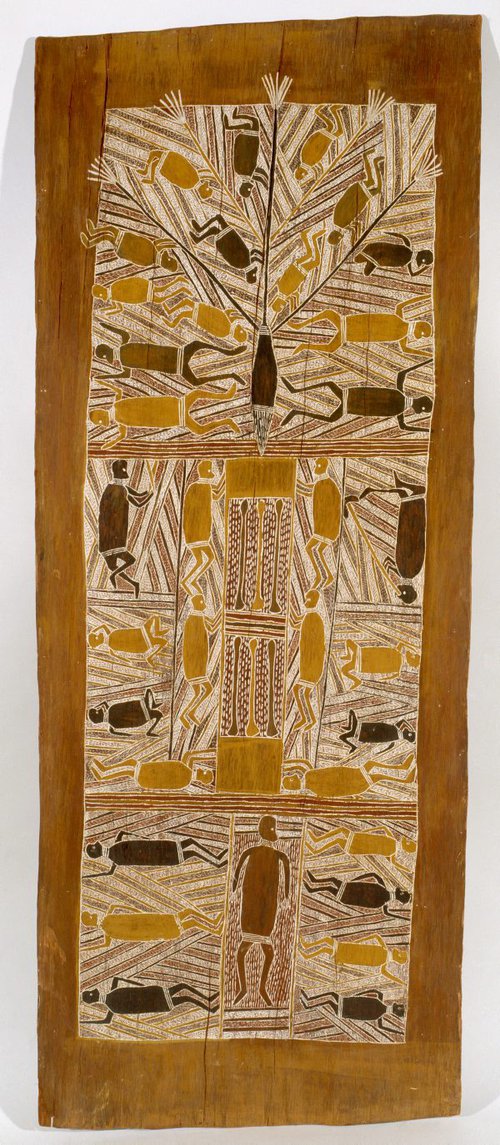
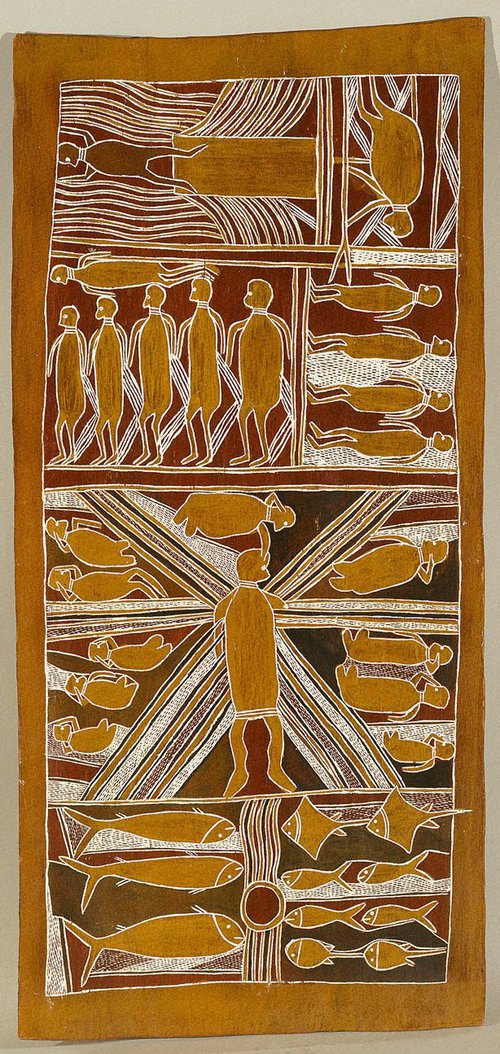
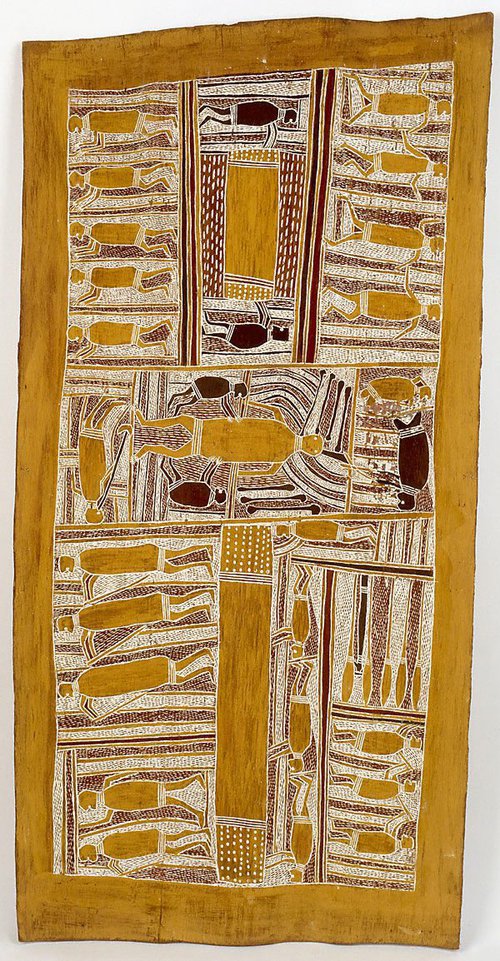
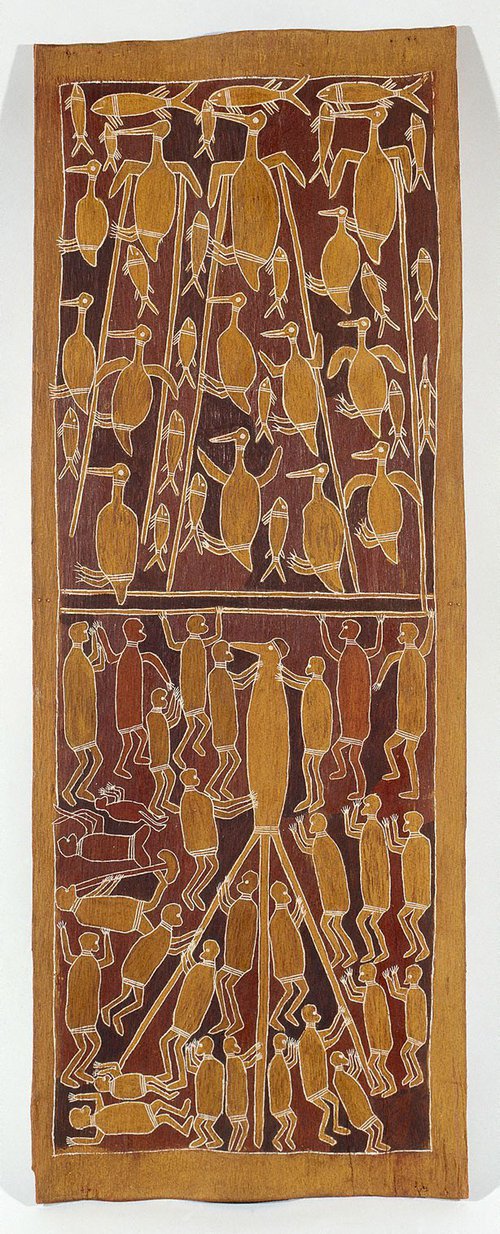
The Djan'kawu, a man and two sisters, are the primary ancestral creator beings for the Dhuwa moiety of central and north eastern Arnhem Land. Yalangbara, where the Djan'kawu landed after their canoe journey from Burralku (an island to the east), is the most important location painted by Mawalan Marika. The Marika family consider themselves to be Mayarr Mayarr – the children of the Djan'kawu. In a series of five large bark paintings, Marika depicted the Djan'kawu journey by canoe across the sea, and their activities after they landed at Yalangbara. These paintings are considered to be the most comprehensive visual narratives of the Rirratjingu ancestral song cycle in existence.
'Djan'kawu creation story', 1959, portrays the verses from the song cycle that tell of the Djan'kawu Sisters travelling to different locations and giving birth to the Dhuwa clans. The lower panel refers to the Sisters giving birth at Arnhem Bay and later at Milingimbi, above. Marika also includes eight mawalan (sacred digging sticks) that the Djan'kawu plunged into the ground, creating waterholes, sacred trees and food-bearing plants. To the right of this, the Djan'kawu watch a sunrise and sunset. The top panel shows the death of the Sisters at Galiwin'ku (Elcho Island), while Djan'kawu the man is shown at Yalangbara contemplating the mawalan and singing.
The two carved, wooden Djan'kawu, ancestral being[s] of the Dhuwa moiety, 1960, are painted with ceremonial body designs and decorated with human hair, feathered pendants and bark aprons. Marika's figures are rare, three-dimensional representations of these miraculous ancestors.
Marika was a great law man with extensive sacred knowledge. He led key parts of the Djan'kawu and Wawilak ceremonies, which are the basis for most of his paintings. Marika also painted other subjects, including depictions of Murruruma, a Rirratjingu songman and cultural hero, and hunting scenes. He occasionally painted Macassan subjects, recalling the trepang fishing fleets that worked around the north coast of Australia until they were banned in 1907. Marika was one of the first artists at Yirrkala to begin painting barks for sale, and was also one of the first leaders and artists from Arnhem land to visit the southern Australian cities. Marika strongly protested against the activities of mining companies in his country, through letters written by his son, Wandjuk Marika, to the Federal Government in Canberra. Mawalan Marika wilt be remembered as a passionate advocate for his people's cultural and land rights.
Ken Watson in 'Tradition today: Indigenous art in Australia', Art Gallery of New South Wales, Sydney, 2004
© Art Gallery of New South Wales
-
Places
Where the work was made
Yirrkala
-
Exhibition history
Shown in 10 exhibitions
Australian Aboriginal art: bark paintings, carved figures, sacred and secular objects: an exhibition arranged by the State art galleries of Australia, 1960-1961, Art Gallery of New South Wales, Sydney, 17 Aug 1960–18 Sep 1960
Australian Aboriginal art: bark paintings, carved figures, sacred and secular objects: an exhibition arranged by the State art galleries of Australia, 1960-1961, Queensland Art Gallery, South Brisbane, Oct 1960–Oct 1960
Australian Aboriginal art: bark paintings, carved figures, sacred and secular objects: an exhibition arranged by the State art galleries of Australia, 1960-1961, National Gallery of Victoria [Swanston Street], Melbourne, Nov 1960–Dec 1960
Australian Aboriginal art: bark paintings, carved figures, sacred and secular objects: an exhibition arranged by the State art galleries of Australia, 1960-1961, Western Australian Art Gallery, Perth, Feb 1961–Mar 1961
Australian Aboriginal art: bark paintings, carved figures, sacred and secular objects: an exhibition arranged by the State art galleries of Australia, 1960-1961, National Gallery of South Australia, Adelaide, Apr 1961–Apr 1961
Australian Aboriginal art: bark paintings, carved figures, sacred and secular objects: an exhibition arranged by the State art galleries of Australia, 1960-1961, Tasmanian Museum and Art Gallery, Hobart, May 1961–Jun 1961
Purchases and Acquisitions for 1960, Art Gallery of New South Wales, Sydney, 22 Mar 1961–23 Apr 1961
Aratjara: art of the first Australians, Stiftung Kunstsammlung Nordrhein-Westfalen, Germany, 23 Apr 1993–04 Jul 1993
Aratjara: art of the first Australians, Hayward Gallery, London, 23 Jul 1993–10 Oct 1993
Aratjara: art of the first Australians, Louisiana Museum of Modern Art, Denmark, 11 Feb 1994–23 May 1994
A material thing - Objects from the collection, Art Gallery of New South Wales, Sydney, 31 Aug 1998–09 Feb 1999
Australian icons: twenty artists from the collection, Art Gallery of New South Wales, Sydney, 04 Aug 2000–03 Dec 2000
Yalangbara, Art Gallery of New South Wales, Sydney, 11 May 2006–23 Jul 2006
One sun, one moon, Art Gallery of New South Wales, Sydney, 03 Jul 2007–02 Dec 2007
Open Air: Portraits in the landscape, National Portrait Gallery [Parliamentary Zone], Canberra, 04 Dec 2008–01 Mar 2009
Yalangbara: art of the Djang'kawu, National Museum of Australia, Canberra, Canberra, 09 Dec 2010–25 Sep 2011
Yalangbara: art of the Djang'kawu, Museum and Art Galleries of the Northern Territory, Darwin, 26 Nov 2011–17 Jun 2012
Yalangbara: art of the Djang'kawu, Western Australian Museum, Perth, 17 Nov 2012–24 Feb 2013
Sentient lands, Art Gallery of New South Wales, Sydney, 04 Jun 2016–08 Oct 2017
Sentient lands, Art Gallery of New South Wales, Sydney, 21 Jan 2017–08 Oct 2017
-
Bibliography
Referenced in 9 publications
-
Edmund Capon AM, OBE, Steven Miller, Tony Tuckson, James Scougall, Mollie Gowing, Harry Messel, Craig Brush, Ronald Fine, Alison Fine, Gordon Davies, Rosalind Davies, Christopher Hodges, Helen Eager, Rosemary Gow, Sandra Phillips, Daphne Wallace and Ken Watson, Gamarada, Sydney, 1996, 30 (colour illus.).
-
Jonathan Cooper (Editor), The Art Gallery of New South Wales Bulletin, 'Yiribana Aboriginal & Torres Strait Islander Gallery', pg. 6-9, Sydney, Apr 1995-May 1995, 6 (colour illus.).
-
Frederick D. McCarthy, Australian Aboriginal art: bark paintings, carved figures, sacred and secular objects: an exhibition arranged by the State art galleries of Australia, 1960-1961, 'Introduction', pg. 7-17, Sydney, 1960, 22 (illus.), 32, 33. plate no. 9; cat.no. 100
-
Ewen McDonald, AGNSW Collections, 'From Colonialism to late Modernism', pg. 7-106, Sydney, 1994, 89 (colour illus.).
-
Hetti Perkins and Ken Watson, A material thing - objects from the collection, Sydney, 1999.
-
Hetti Perkins and Margie West, One sun one moon: Aboriginal art in Australia, ‘Banduk Marika in conversation’, pg. 78-83, Sydney, 2007, 83 (colour illus.).
-
Paul S.C. Tacon, Aratjara: art of the first Australians, 'The Power of the Image among the Past and Present Peoples of Arnhem Land', pg. 127-196, Dusseldorf, 1993, 182 (colour illus.), 337. cat.no. 50
-
Ken Watson, Tradition today: Indigenous art in Australia, 'Mawalan Marika', pg. 78, Sydney, 2004, 78 (colour illus., right figure).
-
Margie West (Editor), Yalangbara: art of the Djang'kawu, 'The Journey of the Djang'kawu: Mawalan 1 Marika', pg. 12-19, Darwin, 2008, front cover (colour illus.), 12 (colour illus.).
-