Title
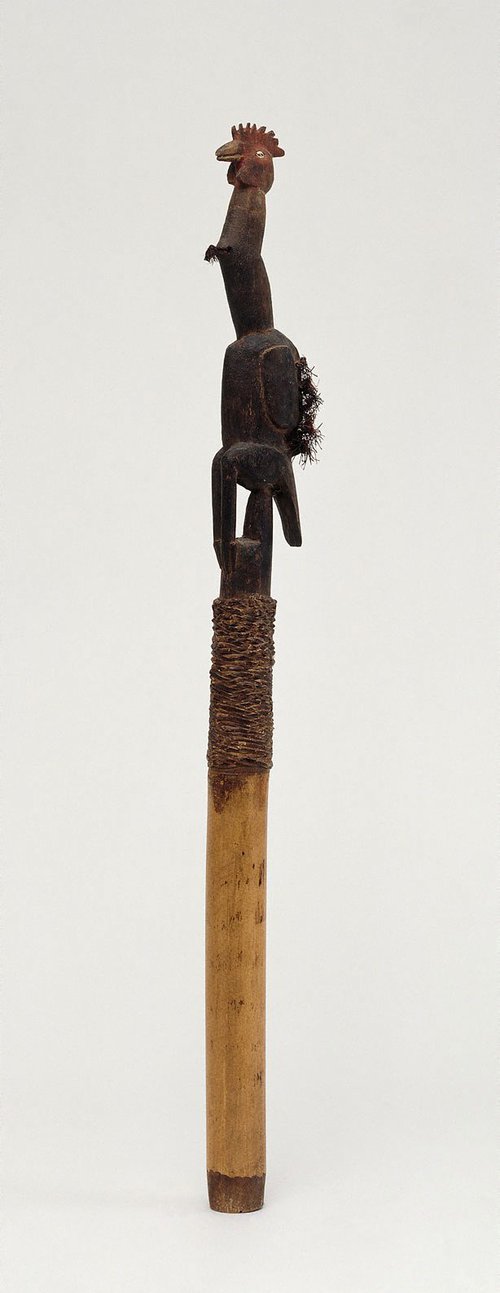
Kaua tikit (orator's stool)
early 20th century-mid 20th century
Artist

-
Details
- Other Titles
- Debating stool
Ceremonial debating stool
Ceremonial stool
kawa teket
kawa rigit
teket - Place where the work was made
-
Middle Sepik River
→
East Sepik Province
→
Papua New Guinea
- Cultural origin
- Iatmul people
- Date
- early 20th century-mid 20th century
- Media categories
- Sculpture , Ceremonial object
- Materials used
- carved wood, conus shell, cane, red and white natural earth pigments
- Dimensions
- 136.5 38.0 x 34.0 cm overall; 52.0 cm height stool
- Credit
- Purchased 1962
- Location
- Not on display
- Accession number
- IA161.1962
- Copyright
- © Iatmul people, under the endorsement of the Pacific Islands Museums Association's (PIMA) Code of Ethics
- Artist information
-
Iatmul people
Works in the collection
- Share
-


-
About
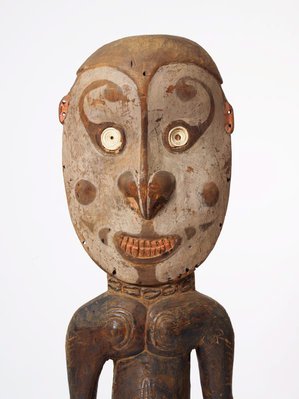
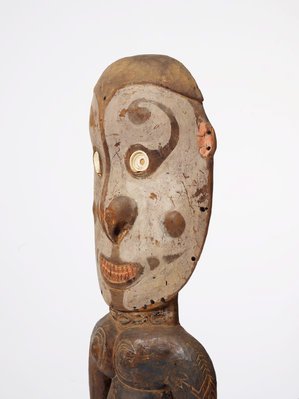
Claytus Yambon of Korogo village describes four types of 'tikit' (stool) found in Iatmul villages: 'vala tikit' (canoe stool), 'gaai tikit' (house stool), 'geko tikit' used by men in the 'geko' (men's ceremonial house), and the 'kaua tikit', found in the centre of every 'geko'. When men debate, the leaves of the 'kaua' (Cordyline) plant are placed one by one on the 'kaua tikit' to emphasise a point.
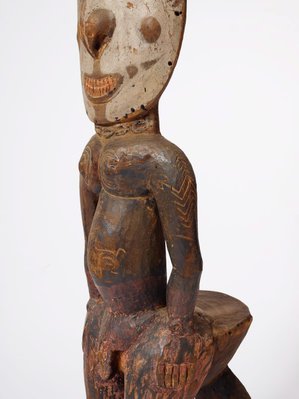
'Kaua tikit' and the sacred 'garamut' slit drum represent the village, and the power to control the village is sounded on the 'kaua tikit' and the 'garamut' to call the spirits. The body of the figure on this 'kaua tikit' shows ritual scarification marks, with a 'yatjanji' (four-pointed star) surrounding the navel, as conveyed by Toby Wanaki of Tegowi village.
[entry from Exhibition Guide for 'Melanesian art: redux', 2018, cat no 26]
-
Exhibition history
Shown in 5 exhibitions
Australian and Melanesian artifacts, Clune Galleries, Sydney, 13 Jun 1962–27 Jun 1962
Acquisitions 1962, Art Gallery of New South Wales, Sydney, 10 Apr 1963–12 May 1963
Melanesian Art, Art Gallery of New South Wales, Sydney, 20 Apr 1966–22 May 1966
Aboriginal and Melanesian art, Art Gallery of New South Wales, Sydney, 19 Oct 1974 -
Melanesian art: redux, Art Gallery of New South Wales, Sydney, 17 Nov 2018–17 Feb 2019
-
Bibliography
Referenced in 6 publications
-
Art Gallery of New South Wales, 1962 Acquisitions, Sydney, 1963, 106. cat.no. 347
-
Peter Laverty (Editor), Art Gallery of New South Wales Quarterly (vol. 13, no. 4), Sydney, Jul 1972, 697 (illus.). "The primitive art area is temporarily situated on the first floor. Exhibits are from the Sepik River, New Guinea, along with a grave-symbol figure from New Hebrides, in the left foreground". The Teket is seen in the centre of the room, together with other works collected by Tuckson in the 1960s and early 1970s.
-
Hal Missingham (Editor), Art Gallery of New South Wales Quarterly, vol 4, no 3, Sydney, Apr 1963, front cover (illus.).
-
JA Tuckson, Art and Australia, 'Primitive art collection', pg. 76-79, Sydney, Jul 1972, 78 (illus.), 79 (illus.). Reproduction on page 79 show 'Teket' on display in the Primitive Gallery at the Art Gallery of New South Wales in 1972.
-
JA Tuckson, Art Gallery of New South Wales Quarterly, 'Some Sepik River art from the collection', pg. 666-679, Sydney, Apr 1972, 667, 671, 676 (illus.). plate no. 9
-
Tony Tuckson, Melanesian art, Sydney, 1966, 12. cat.no. 117
-