-
Details
- Date
- 1984
- Media category
- Painting
- Materials used
- oil on canvas
- Dimensions
- 121.9 x 121.9 cm stretcher; 132.8 x 132.8 x 8.5 cm frame
- Signature & date
Signed and dated upper verso, pencil ".... 84 Auerbach".
- Credit
- Mervyn Horton Bequest Fund 1985
- Location
- Not on display
- Accession number
- 86.1985
- Copyright
- © Frank Auerbach. Courtesy of Marlborough Fine Art, London
- Artist information
-
Frank Auerbach
Works in the collection
- Share
-


-
About
Like Lucian Freud and Francis Bacon, Frank Auerbach was a member of the School of London,1 regularly exhibiting at the successful Beaux Arts Gallery and later at the Marlborough Gallery. The group's key interest was in representing the environment around them, London's streets, houses and gardens, and friends and neighbours. The only survivor of a Jewish émigré family from wartime Berlin, Auerbach seeks comfort in the familiarity and safety of his local environment. He paints street scenes repeatedly to reflect different seasons of the year and times of the day, or numerous portraits over decades of friendship. He is considered one of Britain's pre-eminent post World War II figurative painters, and although primarily a studio painter, drawing is important in formulating his direct response to the landscape, bodily movements and textures.2
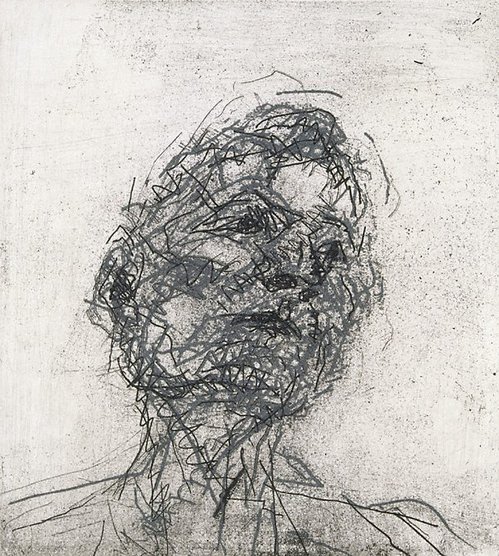
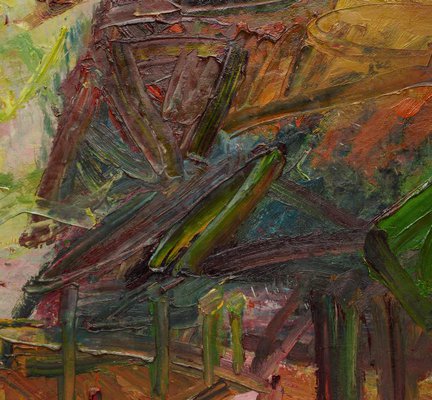
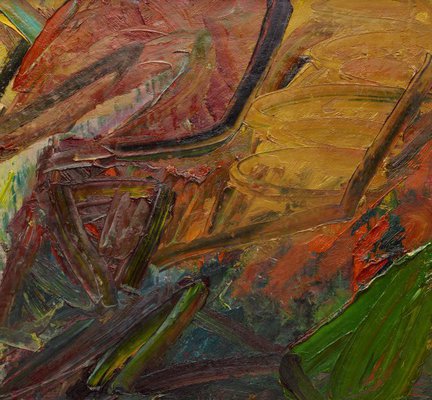
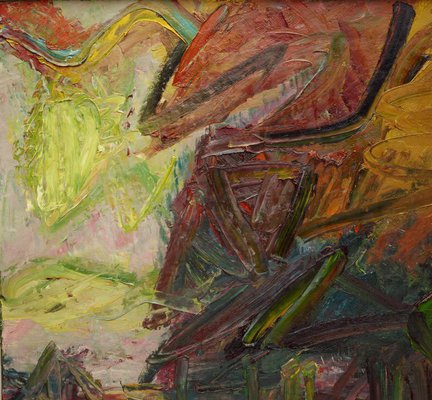
In 'Primrose Hill, autumn', a footpath leads the viewer into an unruly landscape with a threatening canopy of trees and foreboding interior. The usual quiet, autumnal landscape of red and golden falling leaves is presented instead as a windy and savage environs heralding winter's arrival. The layering of paint, which he often applies with his fingers, belies the fact that he often completely dismantles a painting and starts again, as if in the action of creating and re-creating, the work takes on its own life. His portraiture is no less violently imposed upon the canvas. The subject of dozens of portraits, Juliet Yardley Mills is formed anew, in 'JYM Seated IV' 1992 (AGNSW collection), in a surface of oil paint, a medium Auerbach likens to liquid. The excessive piling of paint is almost sculptural, reflecting a concern in common with Bacon: the aim to 'form' the body rather than merely represent it.
The visual rush experienced when viewing Auerbach's works has a distinctly dizzying effect as our meek attempts to keep up with the wildly determined marks are foiled by sudden moments of contemplation. Auerbach's 'pictorial battleground', as art historian and critic Richard Cork has called it, is fought with considered mark-making contrasted with a process of creation and obliteration, forming and erasing. It is as if the initial grid of verticals and horizontals that he employs exists only to be smashed apart to reveal a corpulent underbelly. The process of painting for Auerbach is one of physical tension and activity, which may go on for weeks and where, on conclusion, he feels that he has achieved some 'whole for this overwhelming and unmanageable heap of sensations and impressions'.3
1. The School of London was a term applied by RB Kitaj to describe a group of artists bought together in a figurative exhibition titled 'The human clay' in 1976. The artists included Kitaj, Auerbach, Francis Bacon, Lucian Freud, David Hockney, Howard Hodgkin, Leon Kossoff and Michael Andrews
2. See Catherine Lampert, 'A conversation with Frank Auerbach', 'Frank Auerbach', Hayward Gallery, Arts Council of Great Britain, London 1978
3. Auerbach quoted in Lampert 1978© Art Gallery of New South Wales Contemporary Collection Handbook, 2006
-
Exhibition history
Shown in 6 exhibitions
The British show, Art Gallery of Western Australia, Perth, 19 Feb 1985–24 Mar 1985
The British show, Art Gallery of New South Wales, Sydney, 23 Apr 1985–09 Jun 1985
The British show, Queensland Art Gallery, South Brisbane, 05 Jul 1985–11 Aug 1985
The British show, Royal Exhibition Building, Melbourne, Melbourne, 26 Sep 1985–05 Nov 1985
The British show, National Art Gallery, Wellington, Wellington, 05 Dec 1985–26 Jan 1986
Five years on: a selection of acquisitions 1981-1986, Art Gallery of New South Wales, Sydney, 26 Sep 1986–23 Nov 1986
Acquisitions from the Komon, Salkauskas and Horton Funds, Art Gallery of New South Wales, Sydney, 05 May 1987–31 May 1987
Great gifts, great patrons, Art Gallery of New South Wales, Sydney, 17 Aug 1994–19 Oct 1994
Landscapes of pleasure, from Monet to Hockney, Art Gallery of New South Wales, Sydney, 30 Apr 2016–17 Jul 2016
Some mysterious process, Art Gallery of New South Wales, Sydney, 01 Jun 2020–13 Sep 2020
-
Bibliography
Referenced in 10 publications
-
Art Gallery of New South Wales, Great gifts, great patrons: an exhibition celebrating private patronage of the Gallery, Sydney, 1994. no catalogue numbers
-
Art Gallery of New South Wales, Five years on: a selection of acquisitions 1981-1986, Sydney, 1986, (illus.). cat.no. 115
-
Anthony Bond, The British show, 'Introduction: The selection of the exhibition ', pg.11-16, Sydney, 1985, 13 (colour illus.). Lent by Marlborough Fine Art, London
-
Donna Brett, Contemporary: Art Gallery of New South Wales Contemporary Collection, 'Expression and the figure', pg.108-153, Sydney, 2006, 112, 114, 115 (colour illus.).
-
René Free, Art Gallery of New South Wales handbook, 'European', pg. 36-56, Sydney, 1988, 56, 95 (colour illus.), 96.
-
Renée Free, Art Gallery of New South Wales catalogue of British paintings, Sydney, 1987, 8 (illus.).
-
Bruce James, Art Gallery of New South Wales handbook, 'Western Collection: Paintings and Sculpture', pg. 17-77, Sydney, 1999, 74 (colour illus.).
-
Anne Kirker and Peter Tomory, British painting 1800–1990 in Australian and New Zealand public collections, Sydney, 1997, 35 (colour illus.), 46. cat.no. 52
-
Michael Wardell, Look, 'Mervyn Horton's bequest', pg. 11-12, Sydney, Jun 2004, 11, 12 (colour illus.).
-
Donald Williams and Colin Simpson, Art now: contemporary art post - 1970, 'Frank Auerbach', pg.116-118, Sydney, 1994, 117 (colour illus.). fig.no. 6.9
-