Title
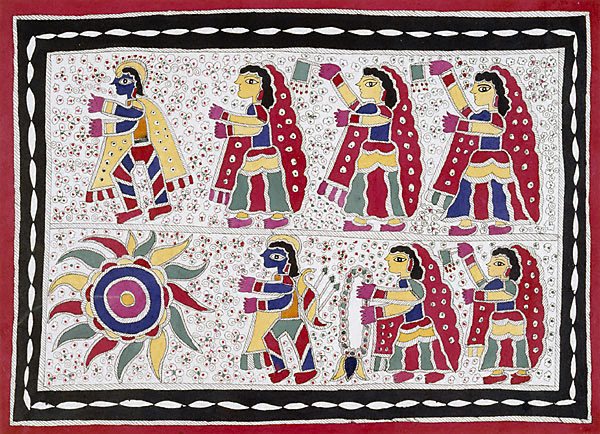
Krishna and the gopis
circa 1980s
Artists
Unknown Artist
-
Details
- Place where the work was made
-
Madhubani
→
Bihar
→
India
- Cultural origin
- Madhubani or Mithila painting
- Date
- circa 1980s
- Media category
- Drawing
- Materials used
- pen and ink on paper
- Dimensions
- 54.4 x 75.0 cm sight; 73.7 x 93.0 x 1.7 cm frame
- Signature & date
Not signed. Not dated.
- Credit
- Gift of Claudia Hyles 1999
- Location
- Not on display
- Accession number
- 80.1999
- Copyright
- © Copyright reserved
- Share
-


-
About
For centuries, Hindu women around Madhubani, in the Mithila region of Bihar, India, have decorated the walls of their village homes with vivid paintings to ward off evil, mark festivals, and commemorate passage rites. This longstanding tradition, however, remained largely unknown to outsiders until the late 1960s, when a severe drought, lasting up to two years, had a devastating impact on the region’s predominantly agrarian society. To provide the community with a non-agriculture-based income, the All India Handicrafts Board then urged the women to create their paintings on paper for commercial purposes and introduced the world to Madhubani or Mithila painting.
The beloved Hindu god Krishna was born a prince but a prophecy foretold that his uncle Kamsa, the demon king of Mathura, would be challenged by a nephew. Kamsa then ordered the deaths of all of his sister’s sons, so Krishna was whisked away
to grow up incognito in a cow-herding village. As a young man he entranced the milkmaids (gopis) of the village and they fell in love with him. Krishna, an avatar of the great god Vishnu, can be identified by his distinctive blue skin. -
Exhibition history
Shown in 1 exhibition
Indian Folk Paintings and Textiles, Art Gallery of New South Wales, Sydney, 29 May 2004–04 Jul 2004
-
Bibliography
Referenced in 1 publication
-
Elizabeth Fortescue, The Daily Telegraph, 'Indian history through art', pg. 91, Sydney, 28 May 2004, 91 (illus.).
-