Title
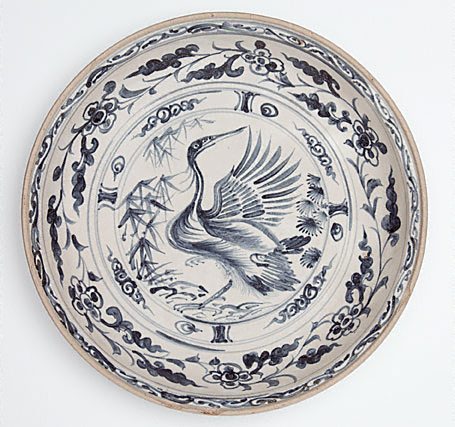
Large dish with crane, pine and bamboo medallion
15th century
Artists
Unknown Artist
-
Details
- Other Title
- Large dish with a central medallion depicting a crane with pine and bamboo
- Place where the work was made
-
Hanoi
→
Vietnam
- Period
- Le dynasty circa 1420 - 1787 → Vietnam
- Date
- 15th century
- Media category
- Ceramic
- Materials used
- porcelain with underglaze blue decoration
- Dimensions
- 8.0 x 38.0 cm
- Signature & date
Not signed. Not dated.
- Credit
- Purchased 1991
- Location
- Not on display
- Accession number
- 7.1991
- Copyright
- Share
-


-
About
The ceramic traditions of Vietnam, which date back to the first century AD, were strongly influenced by those of its omnipresent northern neighbour, China. The so-called 'golden age' of Vietnam - the Ly and Tran dynasties - commenced with Vietnam's independence from China. During a subsequent and short-lived Chinese incursion in the fifteenth century, the great innovation of blue and white porcelain came to Vietnam with migrant potters from the north. Characteristic of the Vietnamese style is the unglazed rim, suggesting that it was fired upside down, and the speckled grey-blue colour of the painted design. The design - a crane amid bamboo and pine (traditional symbols of longevity), with scrolling floral motifs - also echoes the Chinese style.
Art Gallery Handbook, 1999. pg. 299.
-
Places
Where the work was made
Hanoi
-
Bibliography
Referenced in 6 publications
-
Amber Daines, Look, 'Trade Ceramics', pg. 20-21, Sydney, Jun 2004, 20 (colour illus.), 21.
-
Terry Ingram., Arts of Asia, 'Christie's Melbourne: The Brake-Lau-Eckermann Southeast Asian Collection in September', Nov 1990-Dec 1990, 151 (illus.).
-
Bruce James, Art Gallery of New South Wales handbook, 'Asian Collection: South-East Asia', pg. 298-301, Sydney, 1999, 299 (colour illus.).
-
Jackie Menzies (Editor), The Asian Collections Art Gallery of New South Wales, Sydney, 2003, 303 (colour illus.).
-
Jackie Menzies, AGNSW Collections, 'Asian Art - India, South-East Asia, China, Tibet, Korea, Japan', pg. 173-228, Sydney, 1994, 184 (colour illus.).
-
Christie's Melbourne: "The Brake-lau-Eckermann Collection of South East Asian Ceramics, Textiles and Works of Art", Melbourne, Sep 1990, 15 (illus.).
-