


-
Details
- Other Titles
- Portrait of an onnagata
Portrait of an onnagata of the Kabuki theatre - Place where the work was made
-
Japan
- Period
- Shôtoku era 1711-1715 → Edo (Tokugawa) period 1615 - 1868 → Japan
- Date
- 1713
- Media categories
- Scroll , Painting
- Materials used
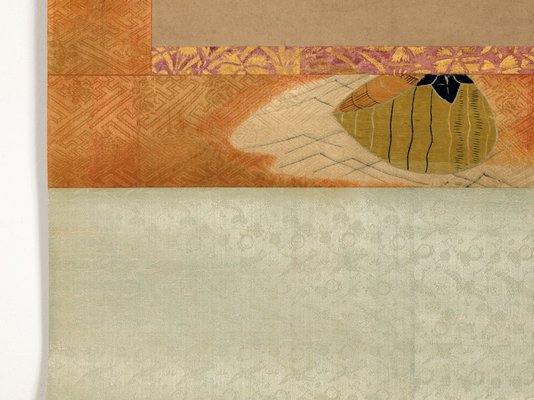
- hanging scroll; ink and colour on paper
- Dimensions
- 110.0 x 53.0 cm image; 209.3 x 75.0 cm scroll (including rollers)
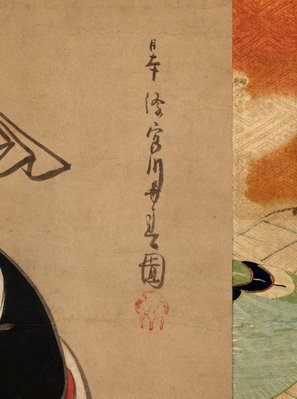
- Signature & date
Not signed. Not dated.
- Credit
- Art Gallery of New South Wales Foundation Purchase 1987
- Location
- Not on display
- Accession number
- 583.1987
- Copyright
- Artist information
-
Miyagawa Chōshun
Works in the collection
- Share
-


-
About
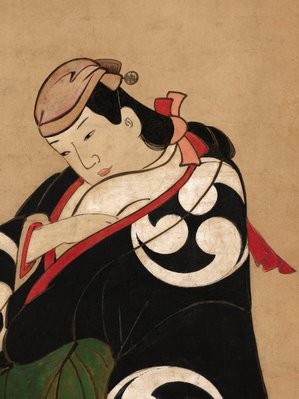
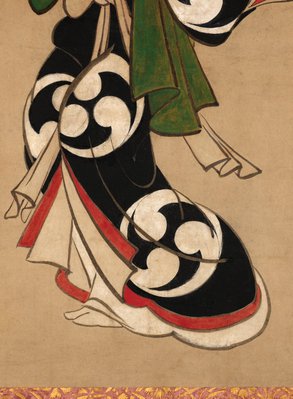
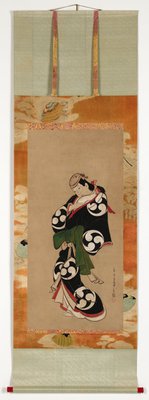
A classic but bold 'ukiyo-e' image, this beautifully poised figure conveys a mood of solitude and studied introspection which contrasts with the showy and dramatic costume. It is an image that combines, in that uniquely Japanese way, qualities of reticence and flamboyance. The nature of the dress, the small, tightly fitting cap, the theatricality of the pose, all suggest that this is an image of an 'onnagata', or female impersonator of the kabuki theatre. Kabuki developed in Edo Japan in response to a growing demand among the emergent mercantile class for a type of theatre more entertaining and accessible than the long-established classic noh theatre patronised by the upper classes. The Edo authorities sought to control possible abuse and prostitution in the new world of the kabuki by banning women and young boys from participating. Thus there arose a role for female impersonators and the 'onnagata' became a skilled, highly appreciated and sought-after category of actors, known for their subtle and convincing portrayal of every nuance of female demeanour.
Art Gallery Handbook, 1999. pg. 277.
-
Places
Where the work was made
Japan
-
Exhibition history
Shown in 4 exhibitions
The Floating World: Japan's World of transient pleasures, Art Gallery of New South Wales, Sydney, 25 May 1994–17 Jul 1994
Great gifts, great patrons, Art Gallery of New South Wales, Sydney, 17 Aug 1994–19 Oct 1994
Beauty and Desire in Edo period Japan, National Gallery of Australia, Canberra, 06 Jun 1998–09 Aug 1998
Heroes and Villains, Art Gallery of New South Wales, Sydney, 19 May 2001–19 Aug 2001
-
Bibliography
Referenced in 13 publications
-
Art Gallery of New South Wales, Great gifts, great patrons: an exhibition celebrating private patronage of the Gallery, Sydney, 1994. no catalogue numbers
-
Edmund Capon AM, OBE, Art Gallery of New South Wales: highlights from the collection, Sydney, 2008, 172, 173 (colour illus.), 174 (colour illus.). The colour illus. on page 174 is a detail of this work.
-
Edmund Capon AM, OBE, Art Gallery of New South Wales Foundation Annual Report 1997, Sydney, 1997, 13 (colour illus.).
-
AJIOKA Chiaki (Curator), Heroes and villains: from Japan's floating world, Sydney, May 2001, 7. cat.no. 3.4
-
Gary Hickey, Artonview, 'Beauty and Desire in Edo Period Japan', pg. 4-7, Parkes, Winter 1998, 6 (colour illus.).
-
Gary Hickey, Beauty & desire in Edo period Japan, 'Men as Women', pg. 13-18, Parkes, 1998, 12 (colour illus.), 14, 70. fig.no. 5
-
Bruce James, Art Gallery of New South Wales handbook, 'Asian Collection: East Asia', pg. 246-287, Sydney, 1999, 276 (colour illus.).
-
Jackie Menzies, AGNSW Collections, 'Asian Art - India, South-East Asia, China, Tibet, Korea, Japan', pg. 173-228, Sydney, 1994, 224 (colour illus.), 225.
-
Jackie Menzies, Orientations, 'Japanese Figure Painting: From the Public to the Personal', pg. 114-119, Hong Kong, Sep 2000, 118 (colour illus.). fig.7
-
Jackie Menzies (Editor), The Asian Collections Art Gallery of New South Wales, 'The Floating World', Sydney, 2003, 247 (colour illus.).
-
Jackie Menzies, The Floating World: Japan's world of transient pleasures, Sydney, 1994, (colour illus.). cat.no. K2
-
Jackie Menzies and Edmund Capon AM, OBE, Asian Collection Handbook, Art Gallery of New South Wales, 'Japanese Painting', pg. 53-69, Sydney, 1990, 63 (colour illus.).
-
Jacqueline Menzies, Art Gallery of New South Wales handbook, 'Asian', pg. 72-93, Sydney, 1988, 82, 86, 87 (colour illus.).
-