Title
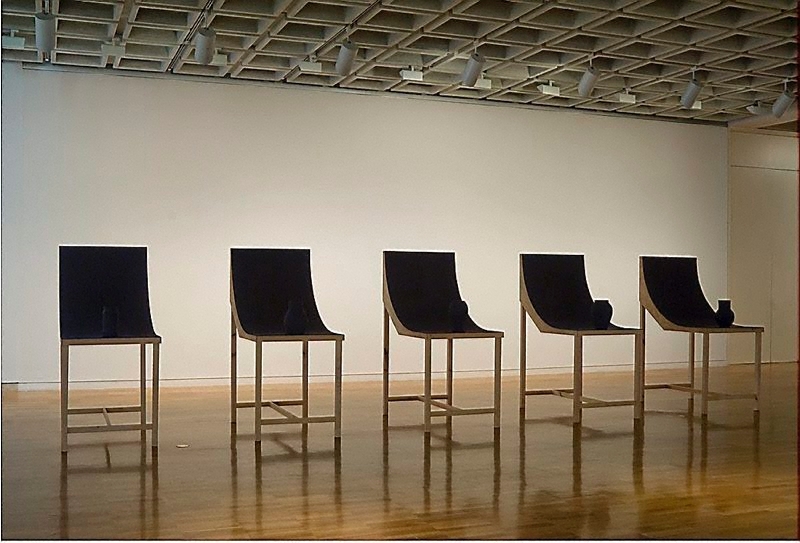
Untitled, Vase Shape #1–5 Vase Shape #1, 1986 from Hugo van der Goes, the Portinari Altarpiece [central panel], 'Adoration of the shepherds' 1476–78 Vase Shape #2, 1989 from Henri Matisse, 'Tabac royal' 1943 Vase Shape #3, 1989 from Henri Matisse, 'Red still life with magnolia' 1941 Vase Shape #4, 1989 from Odilon Redon, 'Bouquet of flowers in a green vase' c1907 Vase Shape #5, 1989 from Odilon Redon, 'Rose, marguerites and cornflowers in green vase' 1912–14
1986-1989
Artist
![Alternate image of Untitled, Vase Shape #1–5
Vase Shape #1, 1986
from Hugo van der Goes, the Portinari Altarpiece [central panel], 'Adoration of the shepherds' 1476–78
Vase Shape #2, 1989
from Henri Matisse, 'Tabac royal' 1943
Vase Shape #3, 1989
from Henri Matisse, 'Red still life with magnolia' 1941
Vase Shape #4, 1989
from Odilon Redon, 'Bouquet of flowers in a green vase' c1907
Vase Shape #5, 1989
from Odilon Redon, 'Rose, marguerites and cornflowers in green vase' 1912–14 by Jacky Redgate](/media/collection_images/5/51.2006.a-k%23view02%23S.jpg)
-
Details
- Date
- 1986-1989
- Media category
- Sculpture
- Materials used
- wood, ceramic, synthetic polymer paint
- Dimensions
-
149.0 x 70.0 x 105.0 cm each stand
:
a - Vase Shape #1, 21.8 cm
b - Vase Shape #2, 26 cm
c - Vase Shape #3, 25.9 cm
d - Vase Shape #4, 25.8 cm
e - Vase Shape #5, 25.8 cm
- Signature & date
Not signed. Not dated.
- Credit
- Rudy Komon Memorial Fund 2006
- Location
- Not on display
- Accession number
- 51.2006.a-k
- Copyright
- © Jacky Redgate
- Artist information
-
Jacky Redgate
Works in the collection
- Share
-


-
About
During and since the 1980s Jacky Redgate has explored the interplay of systems of perception and representation, particularly in relation to photography and what occurs in the translation of three-dimensional 'things in the world' into two-dimensional images. In turn, Redgate has made sculptures and objects which are either impossible to photograph or which are optical or perceptual conundrums. Typologies, the classificatory systems through which multiple examples of something are compared to discover the most prevalent qualities of that thing (the 'type'), are another subject of interest to Redgate: photography's ability to document visually and circulate information has been frequently used in typological research.
As the historian and critic Ross Gibson has said, "artwork such as Redgate's is perhaps best understood primarily as active research", however it is also visually engaging and imaginative, enabling reverie rather than illustrating science. Redgate's use of found and family photographs in some works adds a more personal and subjective dimension.
As with many other artists working at this time, Redgate was also interested in the history of art, and particularly European art which was well known in Australia, but usually through reproductions rather than direct experience of the art works. In this sculpture Redgate has made a series of wooden stands with their top surface painted black, which are both museum plinths and infinity screens. On the plinth/screens sit 5 black vases also painted black, which are based on vases from paintings by Matisse, Redon and Van Der Goes.
An infinity screen is designed to give a sense of endless space behind an object or person filmed or photographed. Of course photographing a black vase on a black background is impossible, and yet the human eye can see and discern the object from its surrounds. Photography's indexical relation to its subject, as the trace of light reflected by the object on chemicals, comes apart under this presentation of object and plinth within the museum. The object itself can not be represented and can only be experienced by the viewer seeing it directly, reinstating an elusive aura of the original which photography has largely replaced, but one which can only be fleetingly grasped.
1. Ross Gibson, 'The colour clavecin', Photofile, no. 38, March 1993, p. 10
-
Exhibition history
Shown in 5 exhibitions
Jacky Redgate 88-89, Mori Gallery, Sydney, 1989–1989
Installation and Objecthood, Perc Tucker Regional Gallery, Townsville, 1993–1993
Installation and Objecthood, Milburn Gallery, Australia, 1993–1993
Installation and Objecthood, Martin Browne Contemporary, Paddington, 1993–1993
Jacky Redgate: survey 1980-2003, Contemporary Art Centre of South Australia, South Australia, 23 Apr 2004–30 May 2004
Jacky Redgate: survey 1980-2003, Perth Institute of Contemporary Arts, Perth, 10 Feb 2005–20 Mar 2005
Jacky Redgate Life of the System, Museum of Contemporary Art, Australia, 28 Nov 2005–05 Mar 2006
Jacky Redgate: the logic of vision, Art Gallery of New South Wales, Sydney, 02 Jun 2012–09 Sep 2012
-
Bibliography
Referenced in 4 publications
-
Contemporary Art Centre of South Australia, Jacky Redgate: survey 1980-2003, 2005.
-
Contemporary Art Centre of South Australia, Jacky Redgate survey 1980-2003, exhibition 2, 2005, cover (colour illus.). Ross Gibson essay
-
Elwyn Lynn, The Australian, 'Watcher in a wry position', pg. 13, Sydney, 23 Jan 1993-24 Jan 1993, 13 (illus.).
-
Martin Browne Contemporary, Installation and Objecthood, 1993.
-