Title
Wantjama
2003
Artist

-
Details
- Place where the work was made
-
Wingellina
→
Ngaanyatjarraku
→
Central and Western Desert
→
Northern Territory
→
Australia
- Date
- 2003
- Media category
- Painting
- Materials used
- synthetic polymer paint on linen canvas
- Dimensions
- 139.5 x 85.2 cm stretcher; 146.5 x 92.5 6.5 cm frame
- Signature & date
Not signed. Not dated.
- Credit
- Purchased 2004
- Location
- Not on display
- Accession number
- 5.2004
- Copyright
- © Tommy Watson. Licensed Yanda Arts
- Artist information
-
Tommy Watson
Works in the collection
- Share
-


-
About
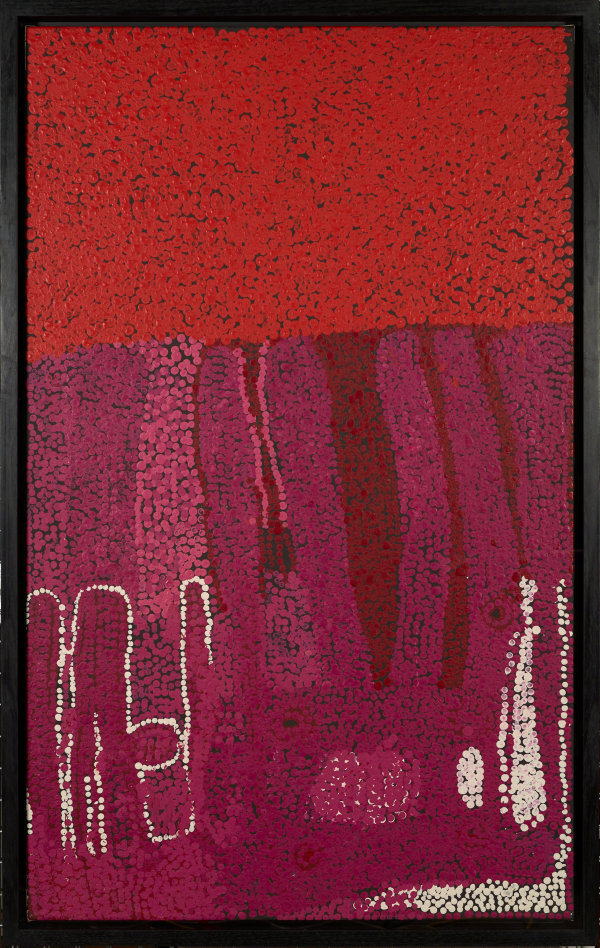
According to documentation from Irrunytju Art Centre, 'Wantjama' tells the story of all the children. Tjitji Tjuta Tjukurrpa. That minyma (woman) Kutungu, she had two children, a boy and a girl at the rockhole, the next night she had more children at another rockhole. She had a lot of children. This country is where Wantjama, her son, was born.
'Wantjama' demonstrates Watson's characteristic field of dots depicting the sacred landscape, his country, through planes of colour that meld and intersect. Colour is used with great sensitivity and authority in all his work and this painting is no exception. The enigmatic shapes in the lower left hand corner, traced with white dots, are balanced by the solid white shapes on the right.
Irrunytju Arts is located in Western Australia 720 kms south-east of Alice Springs, in the Ngaagyatjarra/Pitjantjatjara lands. This new art community exhibited for the first time in 2001. Their vibrant and colourful works have since received much attention from private and public collectors. Tommy Watson has emerged as one of the key artists and this reflects his status in the community as a senior Law man and cultural custodian.
© Australian Art Department, Art Gallery of New South Wales, 2004
-
Exhibition history
Shown in 1 exhibition
Desert Mob 2003, Araluen Arts Centre, Alice Springs, 24 Aug 2003–05 Oct 2003
-
Bibliography
Referenced in 4 publications
-
Araluen Arts Centre, Desert Mob 2003, Alice Springs, 2003. cat.no. IRU03; 2003 List of Works insert in Exhibition Catalogue
-
Kieran Finnane, Alice Springs News, 'Desert's treasures', pg. 1, 8, 9., Alice Springs, 27 Aug 2003, 1, 8.
-
Ken McGreggor and Marie Geissler, Yannima Pikarli Tommy Watson, 'Yannima Pikarli Tommy Watson', pg. 7-13, Melbourne, 2010, 34 (colour illus.). NOTE: Artwork is reproduced horizontally.
-
Jill Sykes (Editor), Look, 'Yrirbana: a facelift and a new show', pg. 28-31, Sydney, Jul 2005, front cover (colour illus.), 7 (colour illus.).
-