Title
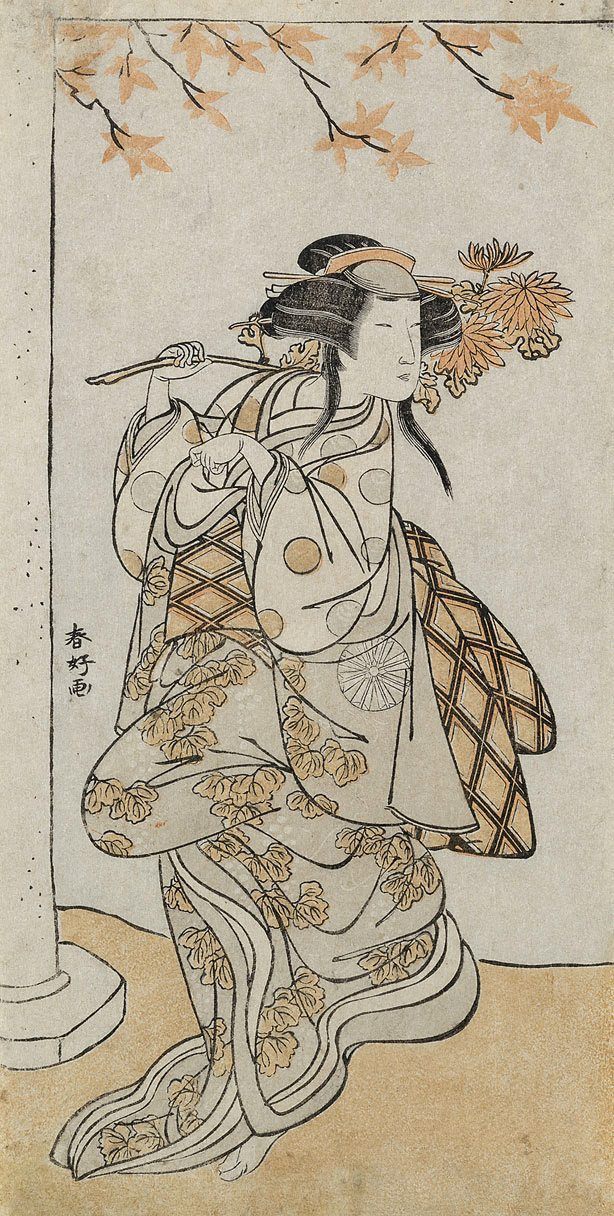
Onnagata Nakamura Noshio dancing in the role of a fox-girl
circa 1794
Artist
-
Details
- Other Titles
- Actor in the role of a woman (Nakamura Noshio I), A dancing kabuki actor
(Actor Nakamura Noshio dancing) - Place where the work was made
-
Japan
- Period
- Edo (Tokugawa) period 1615 - 1868 → Japan
- Date
- circa 1794
- Media category
- Materials used
- woodblock print; ink and colour on paper
- Dimensions
- 29.2 x 14.8 cm
- Signature & date
Signed c.l. in Japanese, ink [incised on block] "Shunkô ga [picture by Shunkô]". Not dated.
- Credit
- Purchased 1930
- Location
- Not on display
- Accession number
- 4351
- Copyright
- Artist information
-
Katsukawa Shunkō
Works in the collection
- Share
-


-
About
In Japanese folklore, the fox is a cunning animal that can assume human form. Here he takes the form of a woman, his hand curled like a forepaw - a clue to the disguise. The small cap worn on the forehead was standard headgear for 'onnagata'. The scene is heavily autumnal, with maple leaves above and the actor carrying chrysanthemums. Shunkô was first among the pupils devoted to the theatre of leading 'ukiyo-e' artist Katsukawa Shunshô (1726-93), founder of the important Katsukawa school.
The Asian Collections, AGNSW, 2003, pg.248.
-
Places
Where the work was made
Japan
-
Exhibition history
Shown in 3 exhibitions
The Floating World: Japan's World of transient pleasures, Art Gallery of New South Wales, Sydney, 25 May 1994–17 Jul 1994
Beauty and Desire in Edo period Japan, National Gallery of Australia, Canberra, 06 Jun 1998–09 Aug 1998
Heroes and Villains, Art Gallery of New South Wales, Sydney, 19 May 2001–19 Aug 2001
-
Bibliography
Referenced in 4 publications
-
AJIOKA Chiaki (Curator), Heroes and villains: from Japan's floating world, Sydney, May 2001, 8. cat.no. 3.17
-
Gary Hickey, Beauty & desire in Edo period Japan, 'Men as Women', pg. 13-18, Parkes, 1998, 14 (colour illus.), 70. fig.no. 7
-
Jackie Menzies, The Floating World: Japan's world of transient pleasures, Sydney, 1994. cat.no. K17
-
Jackie Menzies (Editor), The Asian Collections Art Gallery of New South Wales, 'The Floating World', Sydney, 2003, 248 (colour illus.).
-
-
Provenance
Samurai Shōkai, Yokohama/Kanagawa/Japan, purchased by the Art Gallery of New South Wales 1930.
