-
Details
- Alternative title
- Dochirae yukou
- Place where the work was made
-
Japan
- Period
- Heisei period 1989 - → Japan
- Date
- 1989
- Media category
- Materials used
- woodblock print; ink and colour on paper
- Edition
- 41/200
- Dimensions
- 55.0 x 38.0 cm image; 61.0 x 46.0 cm sheet
- Signature & date
Signed l.r., in Japanese, pencil "Akiyama Iwao [and artist's seal]".
Dated l.c., pencil "1989".- Credit
- Gift of the artist 1993
- Location
- Not on display
- Accession number
- 405.1993
- Copyright
- © Estate of Akiyama Iwao
- Artist information
-
Akiyama Iwao
Works in the collection
- Share
-


-
About
Akiyama was born in Oita and studied at the Taiheiyo art school under the internationally acclaimed Munakata Shiko (1903-1975), an artist who revitalised Japanese folk traditions. Together with Watanabe Sadao and Tsuchiya Masao who also studied under Munakata, Akiyama belonged to the expressive Japanese Folk Art Movement.
Akiyama's own concern is the eternal search for spiritual enlightenment. On a personal level he achieved this through walking, drinking and 'haiku': walking exposes him to the full and varied panorama of life; drinking frees the creative muse while 'haiku' is his means of expression. Akiyama devises his own 'haiku', pithy 17 syllable poems whose ultimate meaning resonates beyond the words themselves. He then combines his 'haiku' with one of his guilelessly minimal images, to create quintessential examples of 'haiga' (literally 'haiku' paintings). The 'haiga' style of painting evolved in the early seventeenth century and represents another example of the long Japanese tradition of uniting visual and poetic imagery. "Haiga' are particularly popular with disciples of Zen who appreciated the concise brevity of the genre.
Since 1978 Akiyama has tried to develop a new series of works in which he seeks to capture with Zen acuteness man's spiritual dilemma as he gropes for meaning through the vastness of the universe. In this series, Akiyama minimally deploys black ink onto rough, untrimmed hand-made paper, the surface of which is enriched with flecks of brown fragments of the outer bark of the paper mulberry. Many of the prints in this series depict a determined figure, dressed for combat, his back to the viewer, valiantly confronting the expansive unknown, his spiritual groping trenchantly articulated by one of Akiyama's own 'haiku'.
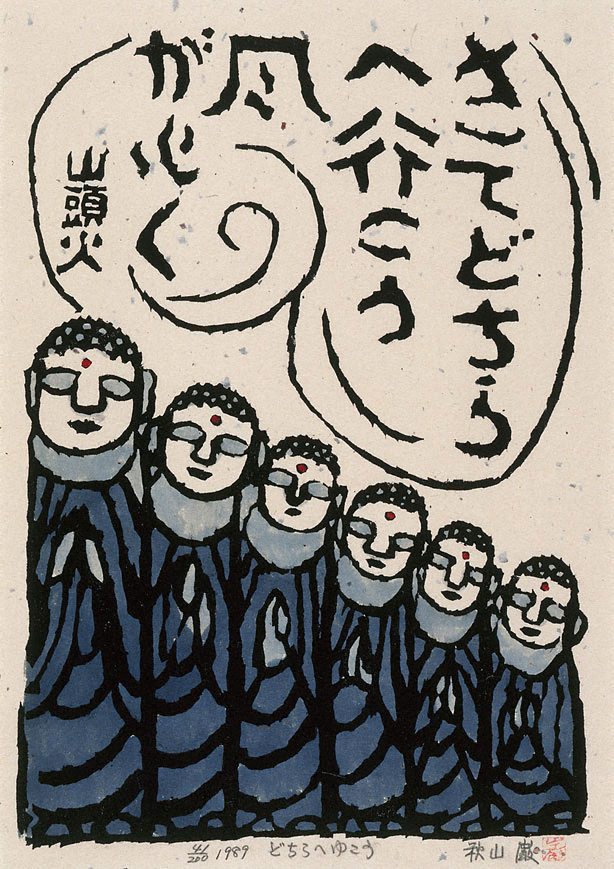
This particular print, first created in 1978 as part of the same series of 'haiga', depicts six images of the popular bodhisattva Jizo, guardian of travellers and children, not only in this life but also in the next. Jizo appears often in folklore and nursery rhymes and images of him usually made of stone and showing him dressed as a priest, appear all over Japan.
One of the exercises for monks in training is the procession out to beg. Here the Jizo evoke one of these wandering precessions, their searching and humane concern echoed in the 'haiku' above: 'Well, which way shall we go/the wind is blowing.'
Jackie Menzies, Contemporary Japanese Prints: The Urban Bonsai, 1992, pg. 21.
-
Places
Where the work was made
Japan
-
Exhibition history
Shown in 2 exhibitions
The Urban Bonsai, Queensland Art Gallery, South Brisbane, 04 Mar 1992–04 May 1992
The Urban Bonsai, National Art Gallery, Wellington, Wellington, 20 Jun 1992–09 Aug 1992
The Urban Bonsai, Christchurch Art Gallery, Christchurch, 12 Sep 1992–29 Oct 1992
The Urban Bonsai, Manawatu Art Gallery, New Zealand, 13 Nov 1992–10 Jan 1993
The Urban Bonsai, The George Adams Gallery, Victorian Arts Centre, Melbourne, 18 Mar 1993–25 Apr 1993
The Urban Bonsai, Art Gallery of New South Wales, Sydney, 08 May 1993–01 Aug 1993
The Urban Bonsai, Penrith Regional Gallery & The Lewers Bequest, Emu Plains, 11 Mar 1994–24 Apr 1994
The Urban Bonsai, Drill Hall Gallery, Australian National University, Canberra, 19 May 1994–19 Jun 1994
The Urban Bonsai, Campbelltown Arts Centre, Campbelltown, 15 Jul 1994–21 Aug 1994
The Urban Bonsai, Bank Art Museum Moree, Moree, 11 Nov 1994–24 Dec 1994
The Urban Bonsai, Tweed Regional Gallery & Margaret Olley Art Centre, Murwillumbah, 01 Feb 1995–05 Mar 1995
Elemental, Art Gallery of New South Wales, Sydney, 30 Jul 2022–2024
-
Bibliography
Referenced in 2 publications
-
Dinah Dysart (Editor), Art and Australia (Vol. 31, No. 1), Sydney, Spring 1993, 92 (colour illus.).
-
Jackie Menzies, Contemporary Japanese Prints : The Urban Bonsai, Sydney, 1992, 10 (colour illus.), 21. cat.no. 21
-
-
Provenance
Akiyama Iwao, 1989-Jul 1993, Japan, donated to the Art Gallery of New South Wales, Sydney, June 1993.