Title
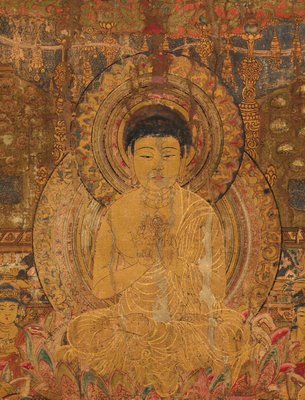
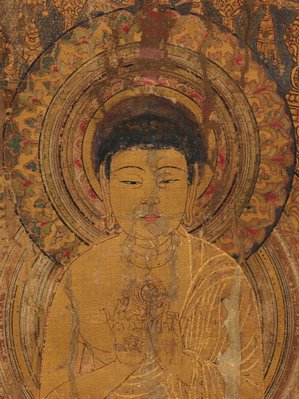
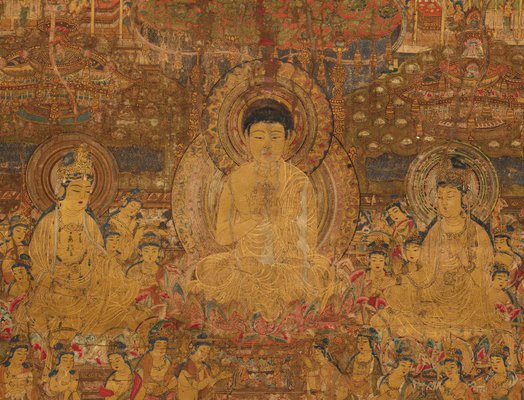
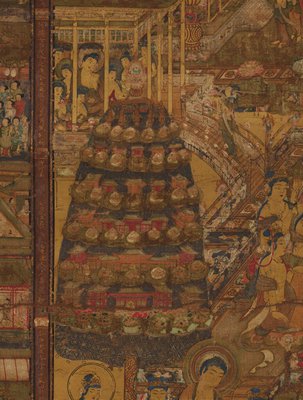
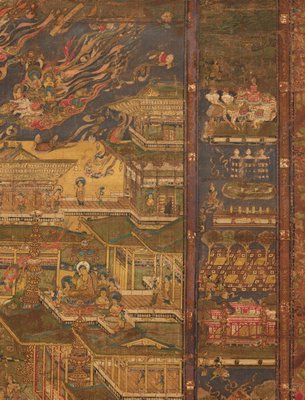
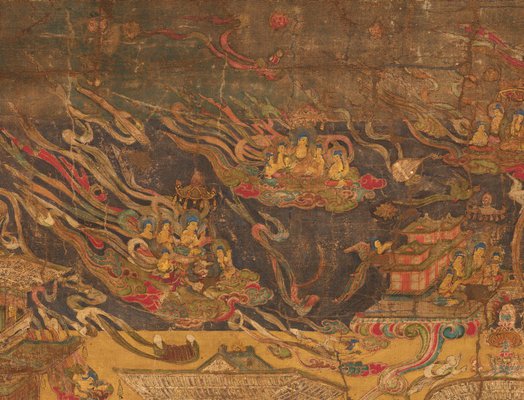
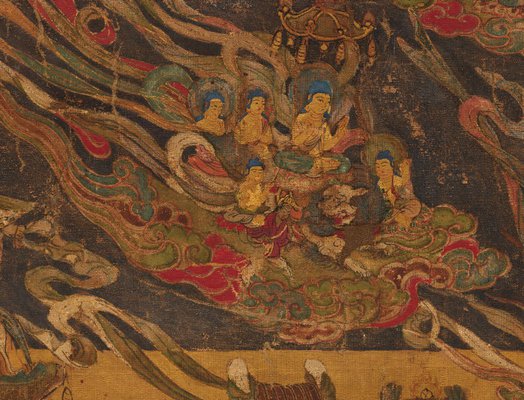
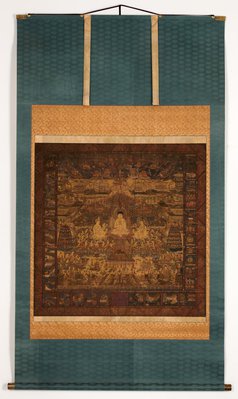
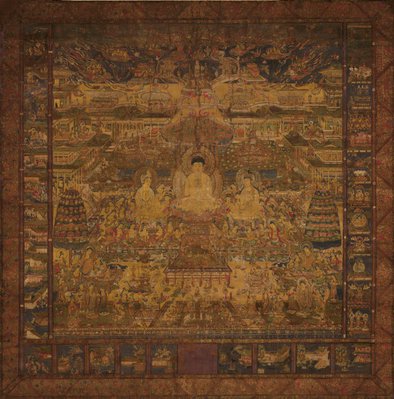
Taima mandala (depicting the Western paradise presided over by Amida Buddha)
early 14th century
Artist

-
Details
- Other Title
- Taima mandala
- Place where the work was made
-
Japan
- Period
- Kamakura period 1185 - 1333 → Japan
- Date
- early 14th century
- Media categories
- Scroll , Painting
- Materials used
- hanging scroll; ink and colour with gold on silk
- Dimensions
- 146.0 x 138.0 cm image; 257 x 145.1 cm scroll
- Signature & date
Not signed. Not dated.
- Credit
- Art Gallery of New South Wales Foundation Purchase 1991
- Location
- Not on display
- Accession number
- 369.1991
- Copyright
- Artist information
-
Pure Land sect
Works in the collection
- Share
-


-
About
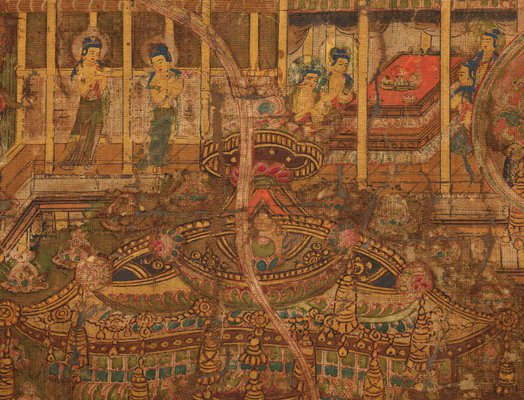
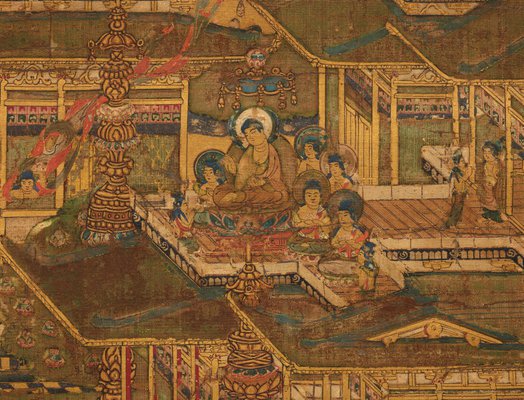
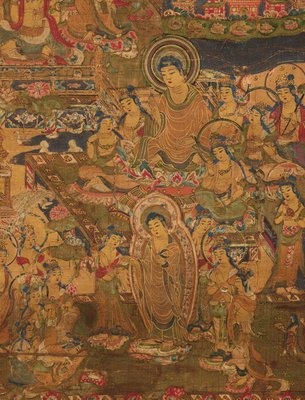
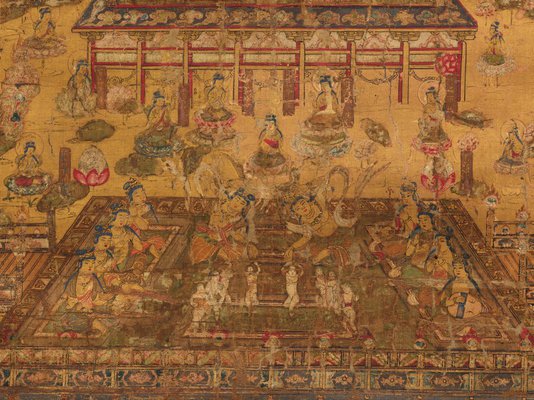
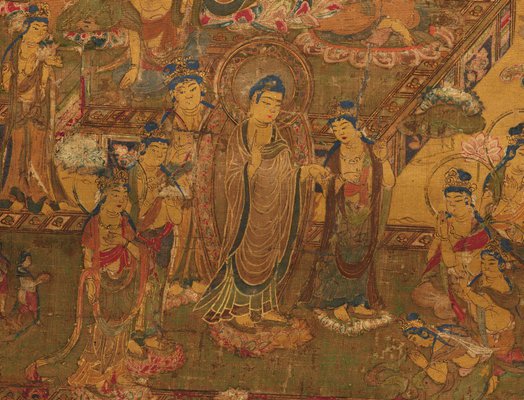
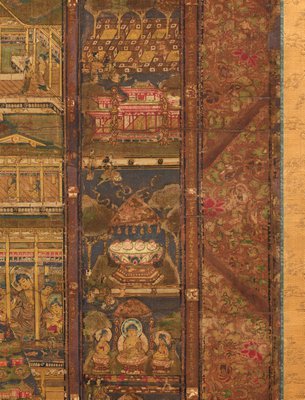
The 'Taima mandala' is one of the most celebrated of the group of works of early Japanese Buddhist art known as the Pure Land mandalas. The prototypes for these mandalas, sacred diagrams of the cosmos, were established in eighth-century China when the Paradise sutras and the realms of Amitabha (Amida) Buddha were gaining widespread popularity. The Chinese sense of order and design is pervasive in the complex layout of gardens, landscape, temples and architecture, all occupied by numerous Bodhisattvas, deities and divine attendants. This painted version of the 'Taima mandala' faithfully replicates the silk original, which according to legend was woven in the eighth century, and is still housed in the Taima-dera monastery south of the ancient capital of Nara. The design is dominated by the central figure of Amida Buddha, attended by his Bodhisattvas Kannon (Avalokiteshvara) and Seishi (Mahasthamaprapta), along with a rich host of deities, attendants and celestial musicians, all presiding over their Western Paradise. The borders also follow the original layout. Depicted on the left side is the story of Prince Ajatasatru. On the right are thirteen of the sixteen contemplations embodying the essentials of Shakyamuni Buddha's teachings. These teach the devotee how to visualise and thereby realise within himself the glories of the Pure Land. Along the lower edge the three remaining contemplations are divided into the nine possible degrees of rebirth into the Western Paradise.
Art Gallery Handbook, 1999. pg. 269.
-
Places
Where the work was made
Japan
-
Exhibition history
Shown in 3 exhibitions
Great gifts, great patrons, Art Gallery of New South Wales, Sydney, 17 Aug 1994–19 Oct 1994
Buddha: Radiant awakening, Art Gallery of New South Wales, Sydney, 10 Nov 2001–24 Feb 2002
Glorious, Art Gallery of New South Wales, Sydney, 27 May 2017–06 Jan 2019
-
Bibliography
Referenced in 9 publications
-
Art Gallery of New South Wales, Great gifts, great patrons: an exhibition celebrating private patronage of the Gallery, Sydney, 1994. no catalogue numbers
-
Edmund Capon AM, OBE, Art Gallery of New South Wales Foundation Annual Report 1997, Sydney, 1997, 18 (colour illus.).
-
Bruce James, Art Gallery of New South Wales handbook, 'Asian Collection: East Asia', pg. 246-287, Sydney, 1999, 269 (colour illus.).
-
Jackie Menzies, AGNSW Collections, 'Asian Art - India, South-East Asia, China, Tibet, Korea, Japan', pg. 173-228, Sydney, 1994, 212, 213 (colour illus.).
-
Jackie Menzies (Editor), Buddha: Radiant awakening, Sydney, 2001, 106 (colour illus.), 116, 117 (colour illus.), 186. cat.no. 83. The colour illus. on page 106 is a detail of this work.
-
Jackie Menzies (Editor), The Asian Collections Art Gallery of New South Wales, 'The art of Buddhism and other worlds', Sydney, 2003, 192-193 (colour illus.). The colour illus. on page 193 is a detail of this work.
-
Adrian Snodgrass, Orientations, 'The Taima Mandala', pg. 110-113, Hong Kong, Sep 2000, 110 (colour illus.), 111 (colour illus.), 112 (colur illus.), 113 (colour illus.). fig.1, 1a -1e (details)
-
Michael Wardell, Look, 'Foundation building', pg.14-17, Sydney, Sep 2004, 15 (colour illus.).
-
Michael Wardell, Look, 'Foundation Building', pg. 14-17, Sydney, Sep 2004, 14, 15 (colour illus.), 17. The colour illus. on page 15 is a detail of this work.
-
