-
Details
- Place where the work was made
-
Japan
- Period
- Edo (Tokugawa) period 1615 - 1868 → Japan
- Date
- circa 1705
- Media category
- Materials used
- woodcut hand applied with urushi (lacquer) and washes of ink
- Dimensions
- 55.7 x 24.2 cm
- Signature & date
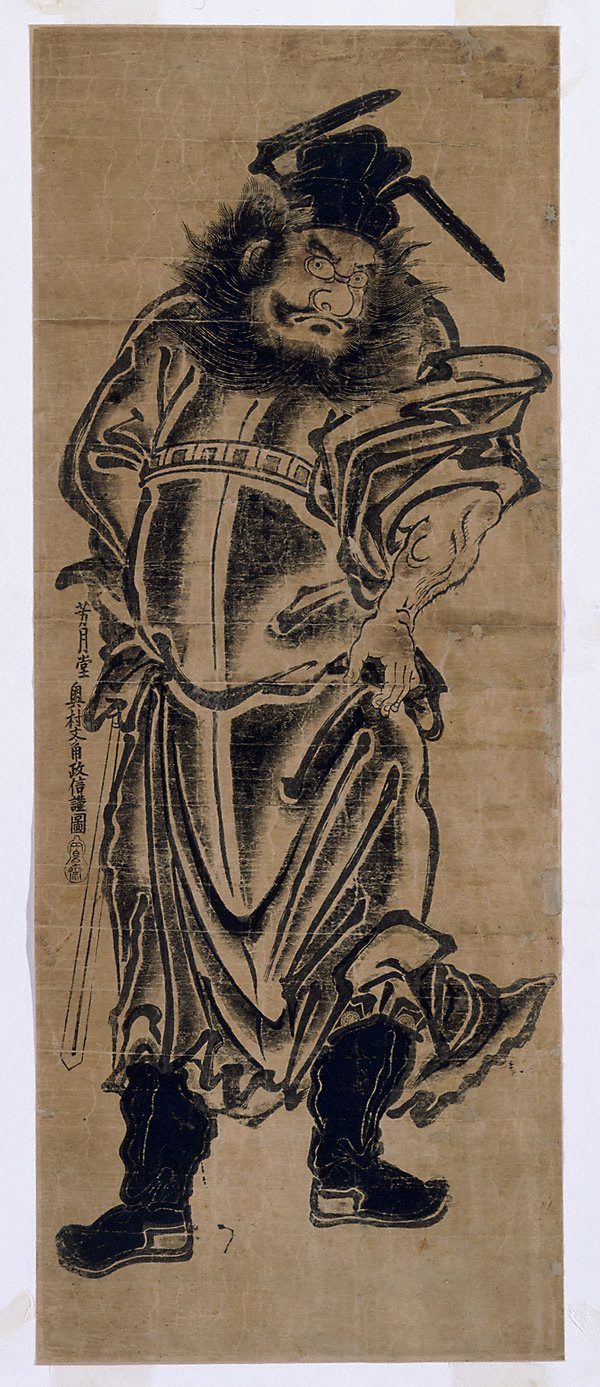
Signed c.l., in Japanese, ink [incised on block] "Hôgetsudô Okumura Bunkaku Masanobu kinzu [picture respectfully by Hôgetsudô Okumura Bunkaku Masanobuand]" [and artist's seal ,"Tanchôsai"].
Not dated.- Credit
- Purchased 1993
- Location
- Not on display
- Accession number
- 338.1993
- Copyright
- Artist information
-
Okumura Masanobu
Works in the collection
- Share
-


-
About
Shoki the demon queller is a good example of a Chinese import into the vast pantheon of Japanese gods and spirits. Legend has it that the Tang emperor Xuan Zong was healed from his illness by Shoki (Chinese name Zhongkui), who appeared in his dream. In the dream Shoki said that he had been an unsuccessful candidate of the official examinations, but found his talent in quelling demons. In Japan, the image of Shoki is most conspicuous on Boy's Day, when people pray for the wellbeing of their male offspring.
The Asian Collections, AGNSW, 2003, pg.198.
-
Places
Where the work was made
Japan
-
Exhibition history
Shown in 2 exhibitions
Four Centuries of Ukiyo-e Prints, Queensland Art Gallery, South Brisbane, 07 May 1997–27 Jul 1997
Heroes and Villains, Art Gallery of New South Wales, Sydney, 19 May 2001–19 Aug 2001
-
Bibliography
Referenced in 4 publications
-
AJIOKA Chiaki (Curator), Heroes and villains: from Japan's floating world, Sydney, May 2001, 7. cat.no. 3.12
-
Verlie Just, Four Centuries of Ukiyo-e Prints, Brisbane, 1997. cat. no: 3
-
Roger S. Keyes, The Male Journey in Japanese Prints, 1989, 76 [illus.]. figure no. 109
-
Jackie Menzies (Editor), The Asian Collections Art Gallery of New South Wales, 'The art of Buddhism and other worlds', Sydney, 2003, 198 (colour illus.).
-