Title
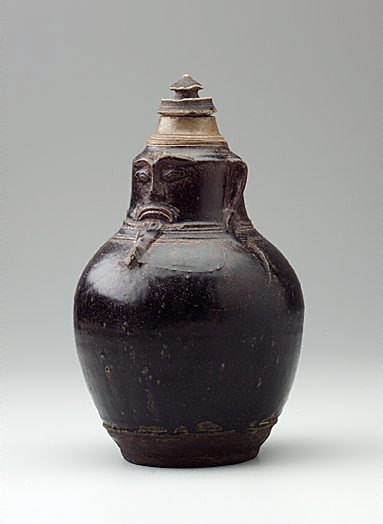
Bottle with anthropomorphic shape
mid 12th century
Artists
Unknown Artist

-
Details
- Other Titles
- Bottle of gourd shape
Bottle with anthropomorphic features - Place where the work was made
-
Cambodia
- Cultural origin
- Khmer
- Period
- Angkor period 802 - 1431 → Cambodia
- Date
- mid 12th century
- Media category
- Ceramic
- Materials used
- stoneware with brown glaze
- Dimensions
- 26.0 cm
- Credit
- Gift of Mr F. Storch 1981
- Location
- Not on display
- Accession number
- 314.1981
- Copyright
- Share
-


-
About
The iconography of this rare covered jar may refer to a meditating sage, or 'rishi', one of the wandering ascetics associated with Hinduism and distinguished by their beards. The form may be that of a mountain, abstracted and translated into the Khmer ceramic idiom. Since mountains were considered the abode of the gods and a place of retreat, they were favourite haunts of ascetics. It is unclear whether this vessel had a specific function: it may be a funerary urn or a holy water jar, or something for everyday use. Although one of the finest examples of this type of Khmer jar, it is still covered in the technically flawed but characteristic smooth, brown glaze that easily flakes.
The Asian Collections, AGNSW, 2003, pg.317.
-
Places
Where the work was made
Cambodia
-
Exhibition history
Shown in 1 exhibition
Conversations through the Asian collections, Art Gallery of New South Wales, Sydney, 25 Oct 2014–13 Mar 2016
-
Bibliography
Referenced in 5 publications
-
Edmund Capon AM, OBE and Jan Meek (Editors), Portrait of a Gallery, 'Asian Art', pg. 106-113, Sydney, 1984, 108 (colour illus.).
-
Jackie Menzies and Edmund Capon AM, OBE, Asian Collection Handbook, Art Gallery of New South Wales, 'South-East Asian Art', pg. 83-96, Sydney, 1990, 91 (illus.).
-
Jackie Menzies, AGNSW Collections, 'Asian Art - India, South-East Asia, China, Tibet, Korea, Japan', pg. 173-228, Sydney, 1994, 180 (colour illus.).
-
Jackie Menzies, Arts of Asia, 'New Dimensions', pg. 54-63, Hong Kong, Nov 2003-Dec 2003, 58 (colour illus.). no.10
-
Jackie Menzies (Editor), The Asian Collections Art Gallery of New South Wales, Sydney, 2003, 317 (colour illus.).
-