-
Details
- Alternative title
- Natura morta
- Date
- 1949
- Media category
- Painting
- Materials used
- oil on canvas
- Dimensions
- 32.5 x 42.0 cm stretcher; 44.5 x 54.8 x 5.0 cm frame
- Signature & date
Signed l.c., grey oil "Morandi". Not dated.
- Credit
- Purchased with funds provided by the Lady Maisie Drysdale Bequest, the Ruth Komon Bequest in memory of Rudy Komon and the Margaret Hannah Olley Art Trust 2004
- Location
- Not on display
- Accession number
- 301.2004
- Copyright
- © Estate of Giorgio Morandi/SIAE. Copyright Agency
- Artist information
-
Giorgio Morandi
Works in the collection
- Share
-


-
About
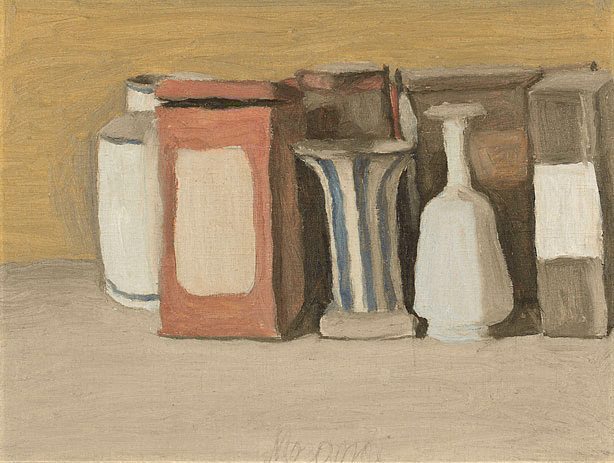
Giorgio Morandi was a reclusive man who specialised in painting still life pictures, called in Italian 'natura morta'. He lived and worked in an apartment in Bologna which he shared with his sisters, in relative isolation from the current art movements. Here he devoted himself to the contemplation of familiar, everyday objects that he had collected over many years, arranging and depicting them with great subtlety. Although they are mostly intimate in scale, Morandi's paintings are strangely grand in feeling. Perhaps this is because his unremarkable, dusty bottles, bowls and vases have been combined and spaced so carefully that they reverberate with an uncanny tension. The pale, often greyish surfaces of inanimate objects in his works acquire a tremulous physicality. Brushing in dry, matte pigments with a sensitively varied touch, Morandi lends an organic quality to the wobbly geometry of the compositions. His still life objects seem bathed in a pearly atmosphere. The opaque surfaces are thoroughly enigmatic, but evoke cloudy skies or times of the day, nuanced moods and qualities of stillness or immensity, all within the confines of a tabletop. In the end, Morandi's silent art becomes a form of meditation.
-
Exhibition history
Shown in 4 exhibitions
Giorgio Morandi, Kunsthalle Bern, Bern, 23 Oct 1965–05 Dec 1965
Less is more: Giorgio Morandi and Gwyn Hanssen Pigott, Newcastle Art Gallery, Newcastle, 05 Mar 2011–08 May 2011
Modernists: selections from the European collection, Art Gallery of New South Wales, Sydney, 07 Nov 2015–25 Apr 2016
Matisse Alive, Art Gallery of New South Wales, Sydney, 11 Oct 2021–03 Apr 2022
-
Bibliography
Referenced in 3 publications
-
Edmund Capon, Look, 'Morandi's visual poetry', pg.11, Sydney, Jun 2005, 11 (colour illus.).
-
Kunsthalle Bern, Giorgio Morandi, Bern, 1965. cat.no 80
-
Lamberto Vitali, Morandi: catalogo generale, Milan, 1983, (illus.). no 680
-
-
Provenance
Galerie d'Art Monte Carlo, Monte-Carlo/Monaco, Purchased by the AGNSW from Galerie d'Art Monte Carlo 2004
Augusto Giovanardi, Milan/Italy, no dates. Listed in Vitali no 680


