-
Details
- Date
- 1967-1968
- Media category
- Painting
- Materials used
- oil on canvas and photostat
- Dimensions
-
painting: 79.0 x 79.0 cm;
text: 65.5 x 65.5 cm frame
:
a - painting, 79 x 79 cm, stretcher
b - text, 65.5 x 65.5 cm, frame
- Signature & date
Signed and dated u.l. verso painting, black fibre-tipped pen "Mel Ramsden/ .../ 1967-8".
- Credit
- Patricia Lucille Bernard Bequest Fund 2003
- Location
- Not on display
- Accession number
- 30.2003.a-b
- Copyright
- © Art & Language/Mel Ramsden
- Artist information
-
Art & Language
Works in the collection
- Share
-


-
About
Art & Language including the Australian artist Ian Burn were at the forefront of International conceptual art practice in the 1960s, and remain active in the critical discussions around the reception of art today.
One of the most interesting tendencies in modern art has been the emphasis placed on the process of reception of art objects rather than on their production. That is to say the phenomenology of the object carries more weight than authorship per se and at the same time the emphasis shifts from representation of objects to an evocation of their presence and perhaps the heightened awareness of the viewer of the act of looking.
Conceptual artists pushed this further asking their reader/viewer to consider the mechanisms of representation rather than the thing being represented. Joseph Kosuth makes this very clear in his work 'One and Three Tables' 1965 from our collection. Here the table itself is presented, as it is, not as a representation, alongside it is a photograph of it taken in the site where it is showing and a dictionary definition of a table.
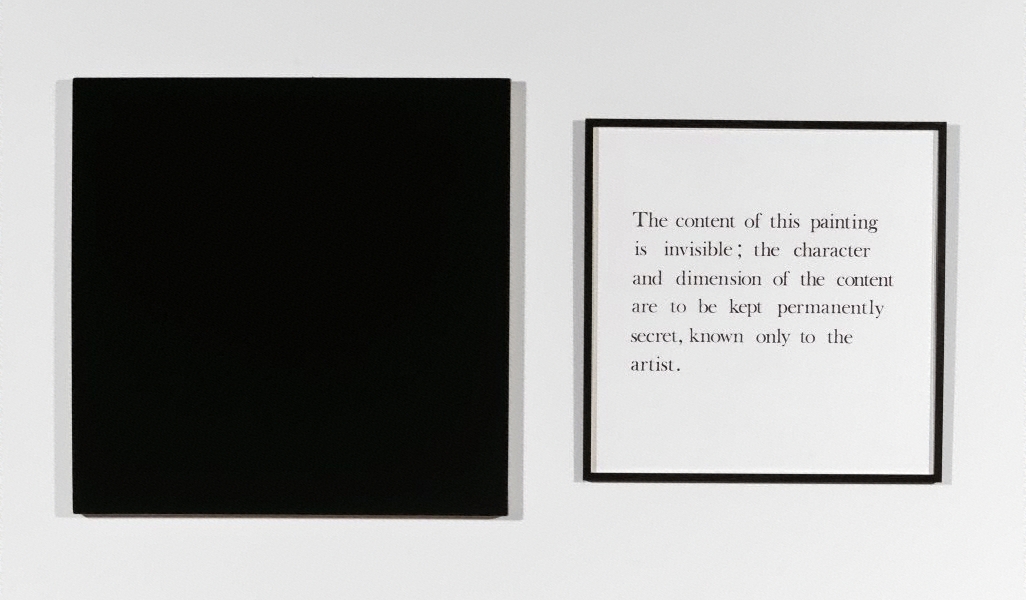
'Secret painting' makes playful reference to the history of monochrome painting. Malevich painting his 'Black square' in 1915 was simultaneously waving an avant-garde flag proclaiming the end of representational art and providing a space for meditation and for the projection of the viewers imagination into the void. Bob Law's 'Blue black indigo black' in our collection takes the form of a black square but within it the careful observer finds layers of blue and indigo that give the black field a sense of deep space in which you can lose yourself or find a hint of the black light of the Gnostics. Similar ideas inform the black square in Kounellis' major installation 'Untitled 1984/1987' also in our collection.
Conceptual artists such as Burn made monochrome pictures as a more pragmatic critique of representation and a call to personal attention on behalf of the viewer. Burn's mirror work in the collection, 'No object implies the existence of any other' 1967 plays with these ideas while making the dogmatic assertion problematic by printing the words on a mirror that throws back the image of the viewer clearly contradicting the text.
In the 'secret' paintings a Duchampian strategy has been used to activate the viewer's imagination. Duchamp once had a collector hide an object inside a ball of string that Duchamp sealed in a metal frame, no one would ever know what it might have been, not even Duchamp.
The importance of shifting the artwork towards an experience of the act of perception on the part of the viewer can be dramatically demonstrated by a work by John Cage in 1952 entitled 4'.33''.This concert consisted of a pianist entering the hall sitting at the piano lifting the lid and then not striking a cord for 4 minutes and 33 second at which point he closed the lid of the piano and left. The audience necessarily became very aware of all ambient sound - a pin drop - the sound of a car in the street etc. The work became a frame for the world rather than a representation of it.
'Secret painting' like the Kosuth has three components a painting that we are led to believe exists, a text assuring us it exists and an overpainting that takes the form of a monochrome which might be considered either as a pure negation of what lies beneath or perhaps as an invitation for the viewer to let the imagination play.
-
Exhibition history
Shown in 8 exhibitions
Arte Conceptuale, Galleria Daniel Templon, Milan, Milan, 1971–1971
New York Art & Language, Galeria Schema, Florence, 1974–1974
Early work 1965-1976, Recent work 1991-1994, Lisson Gallery, London, 03 Jun 1994–09 Jul 1994
Art & Language and Luhmann, Kunstraum Vienna, Vienna, 1995–1995
Art & Language, Kunsthalle St Gallen, Switzerland, 20 Jan 1996–03 Mar 1996
Then and Now, Lisson Gallery, London, 1998–1998
Materializing six years: Lucy R. Lippard and the emergence of conceptual art, Brooklyn Museum, United States of America, 14 Sep 2012–03 Feb 2013
Unpainting, Art Gallery of New South Wales, Sydney, 16 Sep 2017–12 Aug 2018
-
Bibliography
Referenced in 14 publications
-
Ian Burn, Dialogue: writings in art history, 'Conceptual Art as Art', pg.125-130, Sydney, 1991, 128 (illus.), 129. illustration is of 'Secret painting' 1967-68, acrylic on canvas with photostat, 65 x 65cm and 47 x 47cm, Private collection, USA
-
Ian Burn, Art and Australia (Vol. 8, No. 2), 'Conceptual Art as Art', pg.166-9, Sydney, Sep 1970, 169 (illus.).
-
Rex Butler, Australian Journal of Art (vol. XIV, no.2), 'What is the secret of Secret Painting?: On Looking at Seeing and Reading', pg.27-40, Canberra, 1999, 29 (illus.). illustration is of 'Secret painting' 1967-68, oil on canvas and photostat, 46 x 46cm and 100 x 100cm
-
Sandra Danicke, Kunst versteht keine Sau..., 'Welten im Kopf', pg.26-29, Stuttgart, 2012, 26-27 (colour illus.).
-
Galerie Nationale du Jeu de Paume, Art & Language, Paris, 1993, 17 (illus.). illustration is of 'Secret painting' 1967-68, acrylic on canvas and photostat, 40.5 x 41cm and 41 x 91cm, Collection: Musee d'Art moderne, Saint-Etienne, don de Vicky Remy
-
E.H. Gombrich, Word & Image [vol.1, no.3], 'Image and word in twentieth-century art', pg.213-241, London, Jul 1985-Sep 1985, 213, 214 (illus.). fig.1
-
Charles Green, The third hand: collaboration in art from conceptualism to postmodernism, 'Conceptual Bureaucracy: Ian Burn, Mel Ramsden, and Art & Language', pg.25-56, Minneapolis, 2001, 41.
-
Lucy Lippard, Arts Magazine (vol. 47, no. 3), 'Some of 1968', pg.45-47, New York, Jan 1973, 45.
-
Ursula Meyer, Conceptual Art, 'Mel Ramsden', pg.204-5, New York, 1972, 204 (illus.).
-
Musee d'Art Moderne de la ville de Paris, l'art conceptuel, une perspective, Paris, 1989, 105 (illus.). cat.no. 7, illustration is of 'Secret Painting' 1967-68, acrylic on canvas with photostat, canvas: 122 x 122cm, photostat: 91 x 122cm. Collection Bruno Bischofberger, Zürich.
-
Anne Rorimer, New art in the 60s and 70s redefining reality, 'Medium as message/ message as medium', pg.70-111, London, 2001, 101 (illus.).
-
Christian Schlatter, Art conceptuel formes conceptuelles, 'Compendium introductif aux territoires conceptuels', pg.34-69, Paris, 1990, 49, 50 (illus.), 51.
-
Michael Wardell, Contemporary: Art Gallery of New South Wales Contemporary Collection, 'Ideas and actions', pg.60-107, Sydney, 2006, 88, 89 (illus.).
-
Paul Wood, Conceptual Art, 'Art as idea', pg.28-53, London, 2002, 31 (colour illus.). fig.19, illustration is of 'Secret Painting' 1967-68, Liquitex on canvas with photostat, canvas: 122 x 122cm, photostat: 91 x 122cm. Collection Bruno Bischofberger, Zürich.
-