Title
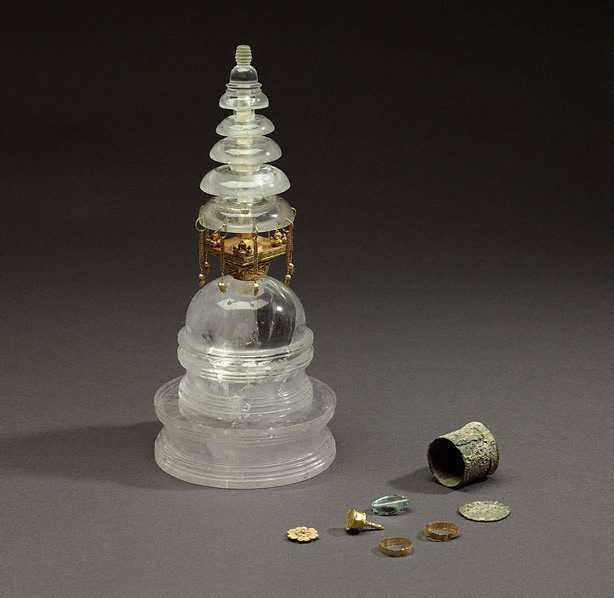
Reliquary stupa
1st century-3rd century
Artists
Unknown Artist
-
Details
- Place where the work was made
-
Swat Valley
→
Ancient Gandhara
→
Pakistan
- Period
- Kushan period mid 1st century - early 5th century
- Date
- 1st century-3rd century
- Media category
- Sculpture
- Materials used
- crystal, gold, copper and pearls
- Dimensions
- 28.0 cm
- Credit
- Purchased 2007
- Location
- Not on display
- Accession number
- 287.2007.a-j
- Copyright
- Share
-


-
About
Originally a funeral mound, constructed either to commemorate a great person or to house his relics, the stupa is the quintessential symbol of the Buddha. While architectural stupas serve as places of worship, smaller ones are used as reliquaries and votive offerings.The veneration accorded a reliquary stupa is determined by its size, rarity and preciousness of the materials from which it is made, such as gold, rock crystal, or silver. This stupa contains a reliquary containing a small gold stupa inside it. The whole ensemble would have been placed within at least one other case, perhaps of stone, before being placed at the base of an architectural stupa.
Asian Art Department, AGNSW, September 2013.
-
Exhibition history
Shown in 2 exhibitions
One hundred flowers (2011), Art Gallery of New South Wales, Sydney, 01 Sep 2011–15 Jan 2012
Glorious, Art Gallery of New South Wales, Sydney, 27 May 2017–06 Jan 2019
-
Bibliography
Referenced in 2 publications
-
Art Gallery of New South Wales, Art Gallery of New South Wales Annual Report 2007-08, Sydney, 2008, 18 (colour illus.).
-
Jackie Menzies, Look, 'The Stupa', pg.27, Sydney, Mar 2008, 27 (colour illus.).
-
-
Provenance
The provenance of this work is under review and records will be updated as new details become available. The Gallery welcomes any information. Contact provenance@ag.nsw.gov.au
Private Collection, 2007, Sydney/New South Wales/Australia, family heirloom of several decades