Title
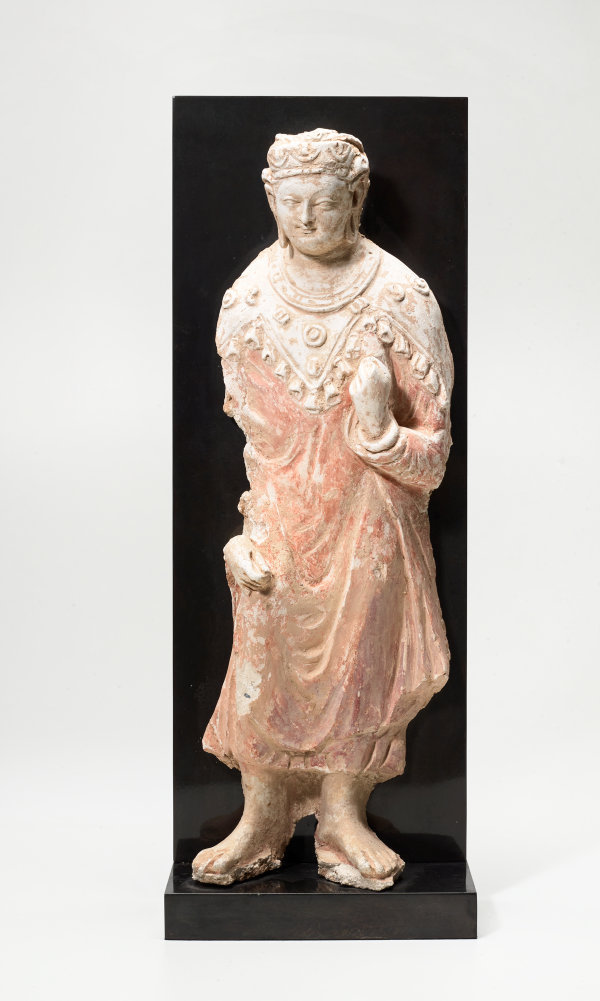
Figure of Buddha
6th century-7th century
Artists
Unknown Artist




-
Details
- Place where the work was made
-
Fonduqistan
→
Ancient Gandhara
→
Afghanistan
- Cultural origin
- Ancient India; Irano-Buddhist - drawing from the influences of the Sassanids, with their origins in ancient Iran, and Gupta India.
- Date
- 6th century-7th century
- Media category
- Sculpture
- Materials used
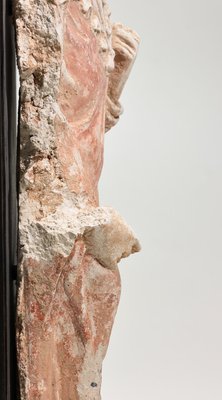
- stucco with traces of pigment
- Dimensions
- 51.5 cm
- Signature & date
Not signed. Not dated.
- Credit
- Purchased 1996
- Location
- Not on display
- Accession number
- 268.1996
- Copyright
- Share
-


-
About
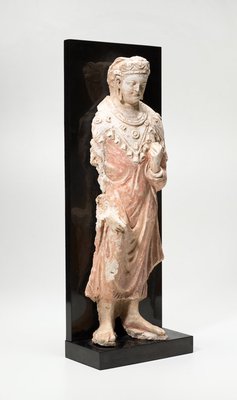
This fragile, and hence rare, stucco image of the Buddha comes from the little-studied temple site of Fonduqistan to the west of present-day Kabul. The figure is an example of the so-called Irano-Buddhist style of Buddhist sculpture found in the region bordering the Hindu Kush northeast of Afghanistan. Ultimately this style had its genesis in the remarkable florescence of Buddhist creativity that distinguished the ancient Indian province of Gandhara during the first four centuries CE. The tasselled, four-pointed chasuble is distinctive to Fonduqistan pieces, while the soft, idealised face with its gentle smile and the naturalistic handling of drapery, body and posture, are part of the Gandharan legacy. His crown indicates he is a monarch, conflating the idea of the Buddha as ruler of the physical and spiritual realms.
The Asian Collections, AGNSW, 2003, pg.27.
-
Exhibition history
Shown in 1 exhibition
Buddha: Radiant awakening, Art Gallery of New South Wales, Sydney, 10 Nov 2001–24 Feb 2002
-
Bibliography
Referenced in 5 publications
-
Isao KURITA, Gandharan Art II The World of the Buddha, 1990, 122, 123 (illus.). no. 335
-
Jackie Menzies (Editor), The Asian Collections Art Gallery of New South Wales, 'Buddhist Art', Sydney, 2003, 27 (colour illus.).
-
Pratapaditya Pal, Orientations, 'Sensuous Spirituality: Hindu and Buddhist Art from the Indic Cultural Realm', pg. 80-87, Hong Kong, Sep 2000, 81 (colour illus.). fig.3
-
David Templeman, Buddha: Radiant awakening, 'Buddha', pg. 64, Sydney, 2001, 64 (colour illus.), 184. cat.no. 46
-
Rebecca. L. Twist, Humanities, 'Images of the Crowned Buddha along the Silk Road: Iconography and ideology', pg.1- 31., Switzerland, Sep 2018, 3 (illus.). fig. 1.
-
-
Provenance
The provenance of this work is under review and records will be updated as new details become available. The Gallery welcomes any information. Contact provenance@ag.nsw.gov.au
The Walmore Collection, 1990, London/England, as published in Isao KURITA; Gandharan Art II: The World of the Buddha; 1990, pg.122-123, no. 335
Alex Biancardi, pre Apr 1996, Australia, purchased by the Art Gallery of New South Wales, Sydney, Apr 1996.