Title
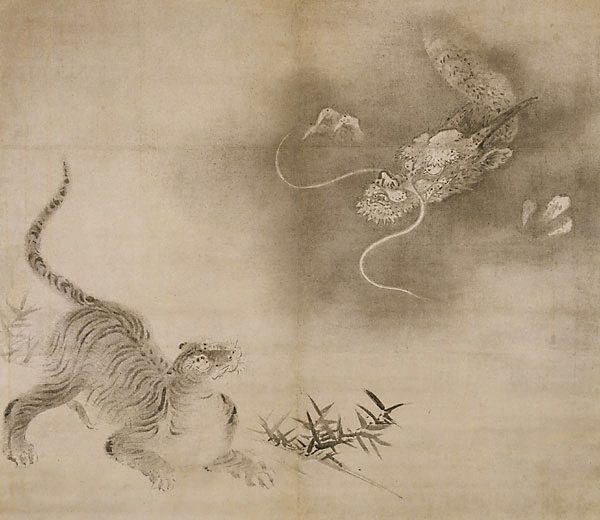
Dragon and tiger
late 16th century-early 17th century
Artist
-
Details
- Place where the work was made
-
Japan
- Period
-
Edo (Tokugawa) period 1615 - 1868
→
Japan
Momoyama period 1573 - 1615 → Japan - Date
- late 16th century-early 17th century
- Media categories
- Scroll , Painting
- Materials used
- hanging scroll; ink on paper
- Dimensions
- 148.3 x 171.1 cm
- Signature & date
Not signed. Not dated.
- Credit
- Purchased 1981
- Location
- Not on display
- Accession number
- 252.1981
- Copyright
- Artist information
-
attrib. Kanô Takanobu
Works in the collection
- Share
-


-
About
In 13th century Japan, with the development of Zen-Buddhist art, a new symbolic meaning was attributed to the dragon representing the soaring spirit of the freed satoric (or suddenly enlightened) soul. The dragon is often accompanied by a tiger, which is associated with the earthbound enlightened mind. Paintings of dragons swirling in the sky among clouds and tigers in a bamboo grove, were highly popular decorations in Zen Temples in the formats of hanging scrolls, sliding doors and folding screen.
The dragon and tiger motif eventually spread from Zen circles into the secular world and especially appealed to the ruling samurai class in the 15th to 10th centuries, since both animals symbolised power, courage and authority.
This dynamic depiction of the dragon and tiger is attributed to Kano Takanobu and was originally pasted on a sliding door in the palace of a samurai warlord. Dragons in Japanese art are usually depicted with three claws, in contrast to the five or four claws usually found on Chinese ones.
Asian Art Department, AGNSW, January 2012
-
Places
Where the work was made
Japan
-
Exhibition history
Shown in 2 exhibitions
Art of the brush, Art Gallery of New South Wales, Sydney, 23 Sep 1995–12 Nov 1995
Dragon (2012), Art Gallery of New South Wales, Sydney, 18 Jan 2012–06 May 2012
-
Bibliography
Referenced in 2 publications
-
Edmund Capon AM, OBE and Jan Meek (Editors), Portrait of a Gallery, 'Asian Art', pg. 106-113, Sydney, 1984, 113 (colour illus.).
-
Jackie Menzies, Art of the Brush - Chinese & Japanese painting calligraphy, Sydney, 1995, 17.
-