Title
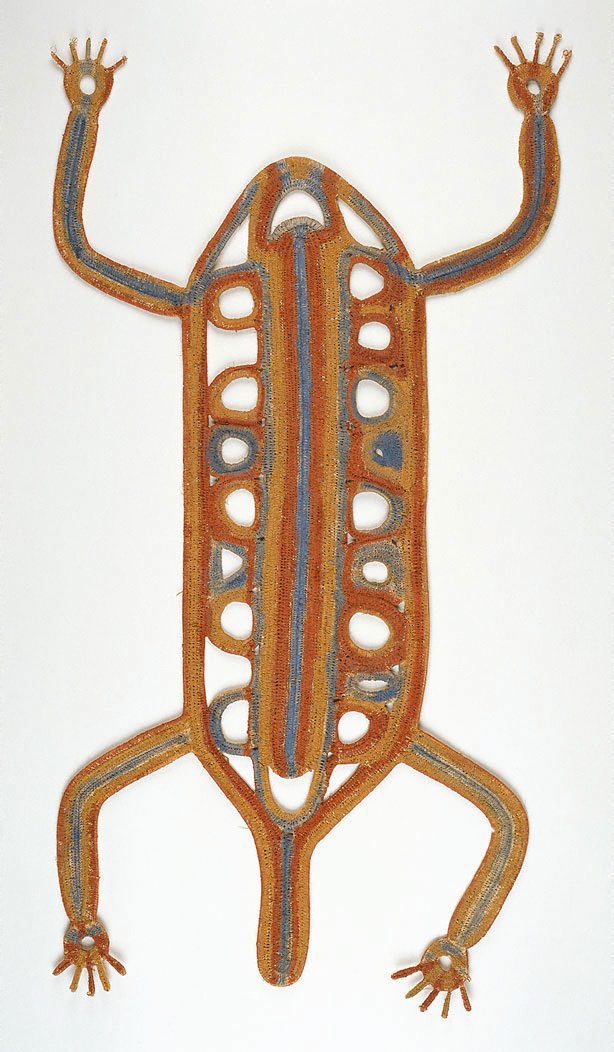
Timbu wara
mid 20th century
collected 1972
Artists
Unknown Artist
-
Details
- Other Titles
- Female figure
Timbuwarra
Timbuwar - Place where the work was made
-
Pangia
→
Southern Highlands Province
→
Papua New Guinea
- Cultural origin
- Wiru people
- Dates
- mid 20th century
collected 1972 - Media categories
- Ceremonial object , Weaving
- Materials used
- coiled plant fibre, cane, yellow and red ochre pigments, blue pigment
- Dimensions
- 144.0 x 77.0 x 1.8 cm
- Credit
- Purchased 1977
- Location
- Not on display
- Accession number
- 243.1977
- Copyright
- Share
-


-
Places
Where the work was made
Pangia
-
Exhibition history
Shown in 1 exhibition
Aboriginal and Melanesian art, Art Gallery of New South Wales, Sydney, 19 Oct 1974 -
-
Bibliography
Referenced in 5 publications
-
Heinz Christian Dosedla, Abhandlungen und Berichte des Staatlichen Museums fur Volkerkunde Dresden [Band 41], 'Kultfiguren aus Flechtwerk im zentralen Hochland von PNG', pg. 86-98, Berlin, 1984. General reference to 'timbu wara' and 'yupin' plaited fibre figures. Figure no. 4 reproduces a similar 'timbu wara' figure from Pangia (Wiru) from the collection of the Peabody Museum, Salem, Mass, USA, Inv.No. E56766
-
Heinz Christian Dosedla, Tribus, 'Kunst und Kunstler im zentralen Hochland von Papua-Neuguinea', pg. 87-119, Stuttgart, Sep 1978. General reference to 'timbu wara' plaited fibre figures, pg. 94-95. Article in German.
-
David Said, OAS Newsletter, 'Exclusive showing of the Moriarty PNG Highlands art collection at the Art Gallery of New South Wales', pg. 2-3, Sydney, Jan 2007, 3 (illus.).
-
Pamela J Stewart and Andrew Strathern, Records of the South Australian Museum, 'Timbu wara figures from Pangia, Papua New Guinea', pg. 65-77, Adelaide, 2001. General reference to 'timbu wara' plaited plant fibre figures.
-
Tony Tuckson, Aboriginal and Melanesian art, Sydney, 1973, 28 (illus.), 49. cat.no. H5
-