Title
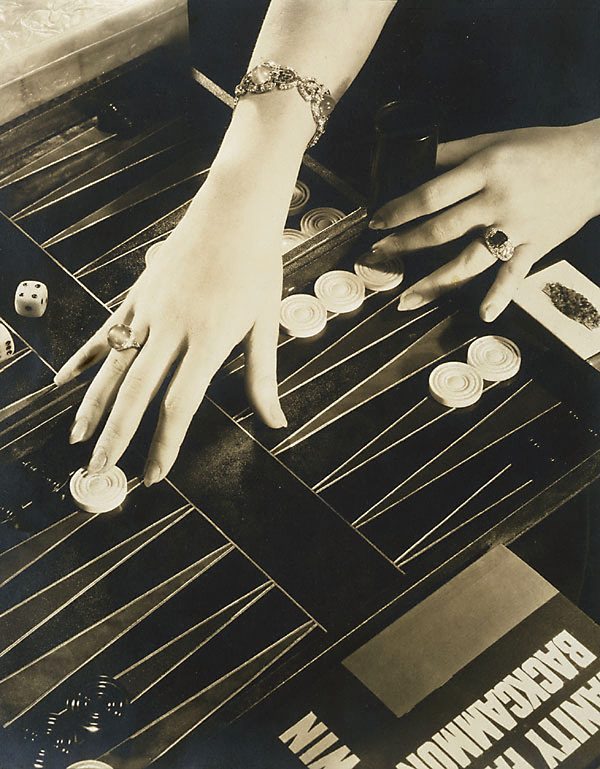
The Play of Modern Hands (hands of Ilka Chase, Backgammon)
1931
Artist
-
Details
- Date
- 1931
- Media category
- Photograph
- Materials used
- gelatin silver photograph
- Dimensions
- 24.3 x 19.5 cm image; 25.4 x 20.2 cm sheet
- Signature & date
Not signed. Not dated.
- Credit
- Purchased 1989
- Location
- Not on display
- Accession number
- 237.1989
- Copyright
- © Estate of Edward Steichen/ARS. Copyright Agency
- Artist information
-
Edward Steichen
Works in the collection
- Share
-


-
About
Edward Steichen was a modernist with a firm foothold in tradition. Five years after he began studies at the Milwaukee Art Students League he had his first photographic exhibition. A year later the work he submitted to the Chicago Print Salon was noted by Clarence White and Alfred Stieglitz. This marked the beginning of their working relationship with Steichen. Steichen joined the Linked Ring Brotherhood, a British Photographic Society dedicated to furthering photography as an art form, and later helped found the Secession movement, which opened its own New York gallery, "291". His career covered a wide range of photographic concerns from the artist to the commercial, the ambiguous to the accessible. Whilst mindful of contemporary issues in photography, his work which at times paralleled that of Stieglitz and Kertesz, was also influenced by developments in painting such as Cubism, Futurism and Abstraction. In 1955 he mounted a huge and internationally influential photography exhibition "The Family of Man".
Art Gallery Handbook, 1994
-
Exhibition history
Shown in 3 exhibitions
Selected recent acquisitions, 1989, Art Gallery of New South Wales, Sydney, 05 Sep 1989–17 Dec 1989
International Photographs from the Collection, Art Gallery of New South Wales, Sydney, 12 Jan 1991–14 Apr 1991
Modernists: selections from the European collection, Art Gallery of New South Wales, Sydney, 07 Nov 2015–25 Apr 2016
-
Bibliography
Referenced in 3 publications
-
Renée Free, AGNSW Collections, 'The Western Heritage, Renaissance to Twentieth Century', pg. 108-172, Sydney, 1994, 152 (colour illus.).
-
Barbara Haskell, Edward Steichen, New York, 2000.
-
Editor Unknown (Editor), American Vogue, United States of America, 15 Mar 1931, 84 (illus.).
-