Title
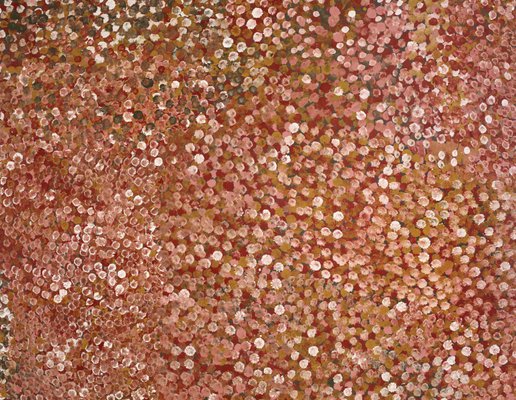
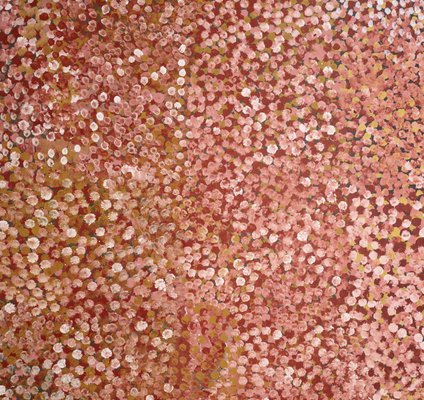
Untitled (Alhalker)
1992
Artist
Emily Kame Kngwarreye
Australia
circa 1910 – 03 Sep 1996
Language group: Anmatyerr, Central Desert region


-
Details
- Places where the work was made
-
Central and Western Desert
→
Northern Territory
→
Australia
Utopia → Northern Territory → Australia
- Date
- 1992
- Media category
- Painting
- Materials used
- synthetic polymer paint on canvas
- Dimensions
- 165.0 x 480.0 x 4.0 cm stretcher
- Signature & date
Not signed. Not dated.
- Credit
- Mollie Gowing Acquisition Fund for Contemporary Aboriginal Art 1992
- Location
- Not on display
- Accession number
- 229.1992
- Copyright
- © Estate of Emily Kame Kngwarreye/Copyright Agency
- Artist information
-
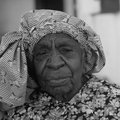 Emily Kame Kngwarreye
Works in the collection
- Share
-


-
About
Working in a remote, north-west corner of the Simpson Desert, on land annexed by pastoral leases during the 1920s, Emily Kame Kngwarreye became, in the final decade of her life, perhaps the most celebrated and sought after Australian artist of her time.
A leading figure in eastern Anmatyerr ceremony, Kngwarreye was also the artist in whose work many white Australians first felt the force of an Indigenous art that could be seen to negotiate a space both within the aesthetics of Western abstraction and the timeless precepts of Aboriginal cultural traditions.
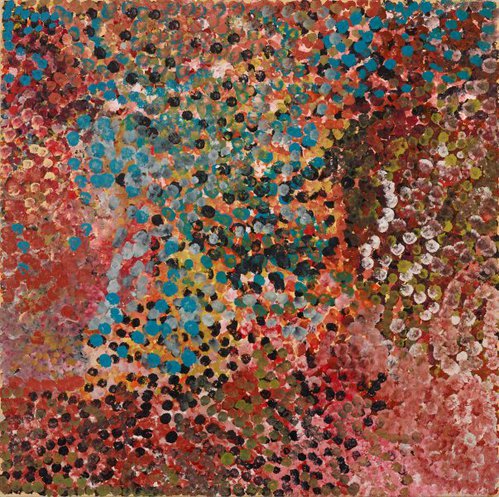
Kngwarreye's 'Untitled (Alhalker)', 1992, has been perceived as a lyrical mapping of country, a poeticising of the desert in bloom, or simply as a spectacular abstract painting. Alhalker, the desert country of Kngwarreye's birth, is anchored by a sacred rock in the form of a spectacular arched monolith, and shaped by the vagaries of the harsh desert environment. From the beginning, Alhalker remained the means and end of Kngwarreye's art.
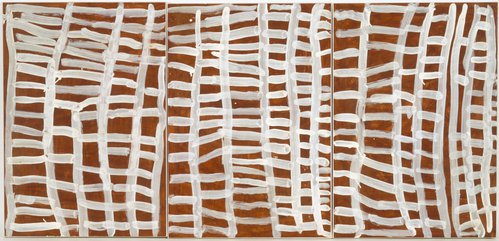
Kngwarreye attained artistic maturity as a woman in her seventies, not long converted to the techniques of painting on canvas, but with decades of painting in a ceremonial context and activity with the Utopia Women's Batik Group behind her – as well as life as a camel handler and stockhand. In an extraordinarily prolific eight years of professional painting, she produced magnificent canvases in which she appears to have aimed for essentialist visions of the multiplicities and connectedness of her country, as imaged in terms of its organic energies. Kngwarreye's vital traceries both conform to, and seem to expand beyond, her clan codes, in abstractions of ceremonial markings and imagery of her country's flora and fauna.
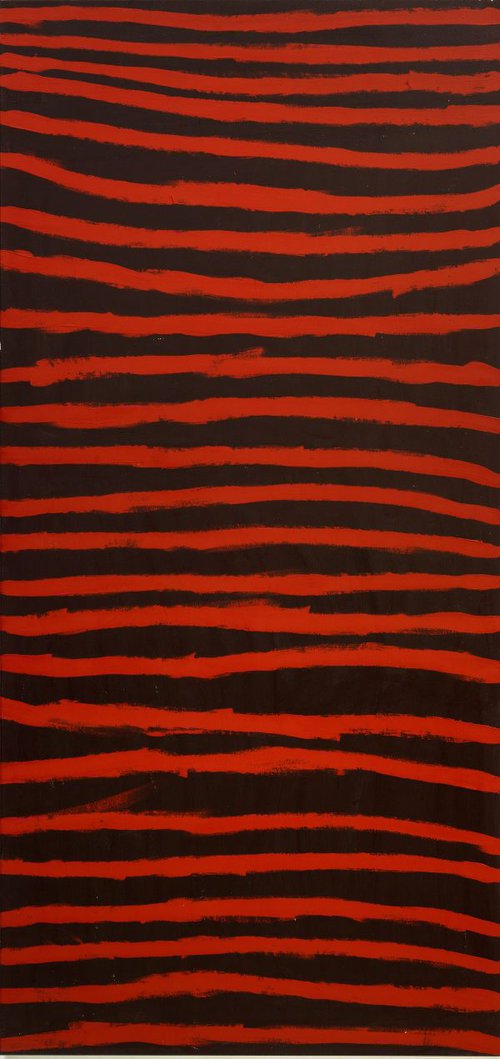
During the early 1990s, Kngwarreye developed a painting technique that literally embodied her sense of the explosive, yet ordered, rhythms of the natural world: she energetically worked her canvas with fluid dots or blobs of colour that formed a pulsing layer over the 'mapped-out' underpinnings of her paintings. Later, she embraced the austerities of stripe compositions in works such as 'Untitled (Awely)', 1994, and in seething, linear 'yam Dreaming' paintings, before she created the remarkable blocky gestural abstractions of 1996, the final year of her life.
Deborah Edwards in 'Tradition today: Indigenous art in Australia', Art Gallery of New South Wales, Sydney, 2004
© Art Gallery of New South Wales
-
Places
Where the work was made
Central and Western Desert, Utopia
-
Exhibition history
Shown in 10 exhibitions
Gamarada, Art Gallery of New South Wales, Sydney, 15 Nov 1996–16 Feb 1997
Terrains, Art Gallery of New South Wales, Sydney, 27 Apr 1999–25 Jul 1999
Title Deeds: Aboriginal and Torres Strait Islander Works from the Collection, Art Gallery of New South Wales, Sydney, 05 Jul 2000–05 Nov 2000
Emily Kame Kngwarreye, National Art Center, Tokyo, Tokyo, 30 Jan 2008–29 Jul 2008
Emily Kame Kngwarreye, National Museum of Art, Osaka, Ôsaka
Country Culture Community (2008-09), Art Gallery of New South Wales, Sydney, 12 Nov 2008–19 Apr 2009
Sentient lands, Art Gallery of New South Wales, Sydney, 04 Jun 2016–08 Oct 2017
Sentient lands, Art Gallery of New South Wales, Sydney, 21 Jan 2017–08 Oct 2017
Know My Name: Australian women artists, National Gallery of Australia, Canberra, 14 Sep 2020–04 Aug 2021
Yiribana Gallery: opening collection display, Art Gallery of New South Wales, North Building, Sydney, 03 Dec 2022–29 May 2023
Emily Kam Kngwarray, National Gallery of Australia, Canberra, 02 Dec 2023–28 Apr 2024
(Emily Kngwarreye), Utopia Art Sydney Pty Ltd, Alexandria
-
Bibliography
Referenced in 12 publications
-
Deborah Edwards, One sun one moon: Aboriginal art in Australia, ‘Histories in the making: Aboriginal Art and modernism’, pg. 51-63, Sydney, 2007, 54-55 (colour illus.).
-
Deborah Edwards, Tradition today: Indigenous art in Australia, 'Emily Kame Kngwarreye', pg. 58, Sydney, 2004, 58, 60-61 (colour illus.).
-
Deborah Edwards, One sun one moon: Aboriginal art in Australia, ‘Histories in the making: Aboriginal Art and modernism’, pg. 51-63, Sydney, 2007, 54-55 (colour illus.).
-
Bruce James, Art Gallery of New South Wales handbook, 'Australian Collection: Aboriginal and Torres Strait Islander Art', pg. 208-241, Sydney, 1999, 232 (colour illus.).
-
NAKADA Masaaki (Editor), Dômo - Australian Living Handbook, Japan, 1999, 16 (colour illus.). plate no. 1
-
Ewen McDonald, AGNSW Collections, 'From Colonialism to late Modernism', pg. 7-106, Sydney, 1994, 103 (colour illus.).
-
Margo Neale and Akira Tatehata, Emily Kame Kngwarreye: Utopia: the genius of Emily Kame Kngwarreye, 'Fields of Dots', pg. 113, Japan, 2008, 140-141 (colour illus.). cat.no. D-25
-
Margo Neale, Yiribana: Aboriginal and Torres Strait Islander collection, Sydney, 1994, 102-3 (colour illus.), 104-5, 137, 139. plate no. 49
-
Margo Neale, Yiribana, Sydney, 1994, 13-14 (colour illus.).
-
Hetti Perkins., Contemporary Aboriginal art: The Mollie Gowing acquisition fund, 'Gifted Contemporary Aboriginal Art: The Mollie Gowing acquisition fund', Sydney, 2006, (colour illus.). not paginated; titled 'Untitled (Alhalker)'
-
Hetti Perkins, Art + soul: a journey into the world of Aboriginal art, 'Dreams + nightmares', pg. 88-153, Carlton, 2010, 150 (colour illus., detail), 151 (colour illus.), 281.
-
Judith White, Look, 'Farewell Jill', pg. 22-23, Sydney, Feb 2015, 22-23 (colour illus.).
-