-
Details
- Date
- (1925)
- Media category
- Materials used
- woodcut, printed in black ink, hand-coloured on ivory laid paper
- Dimensions
- 19.4 x 19.9 cm blockmark (irreg.); 26.5 x 25.4 cm sheet
- Signature & date
Signed l.r., pencil "Thea Proctor". Not dated
Signed with monogram within block to print l.l. corner, "TP".- Credit
- Purchased 1975
- Location
- Not on display
- Accession number
- 223.1975
- Copyright
- © Art Gallery of New South Wales
- Artist information
-
 Thea Proctor
Works in the collection
- Share
-


-
About
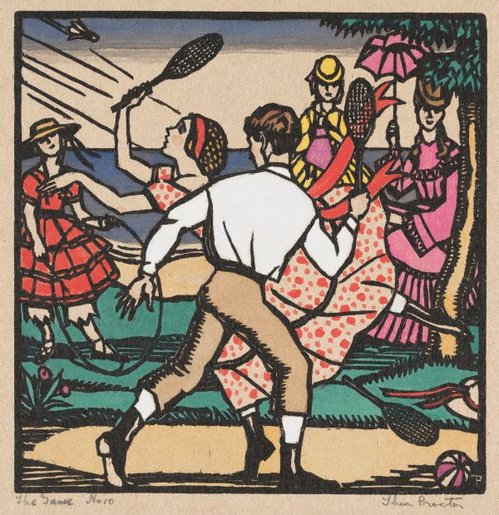
The bold, simplified lines of this work result from Proctor cutting the block in a direct way that acknowledges the demands of the technique. There is minimal or no shading of the forms, unlike 'The rose' which reflects its origin in a shaded pencil drawing. Encouraged by the example of Margaret Preston (who gave her the wood to work with) Proctor made her first woodcuts in 1925, later stating that they were made mainly for
children's nurseries. -
Exhibition history
Shown in 1 exhibition
Australian Collection Focus: Colour, Rhythm, Design - wood & lino cuts of the 20s & 30s, Art Gallery of New South Wales, Sydney, 12 Mar 2010–11 Jul 2010
-
Bibliography
Referenced in 7 publications
-
Helen Campbell, Colour, rhythm, design: wood & lino cuts of the 20s & 30s, 'Introduction', pg. 2, Sydney, 2010, 5 (colour illus.).
-
Janda Gooding, Thea Proctor, Perth, 1982, 8. NOTE: this is not the AGNSW impression
-
Josef Lebovic, Masterpieces of Australian printmaking, Sydney, 1987, 104, 105. NOTE: this is not the AGNSW impression
-
Tracey Lock-Weir., Dorrit Black: unseen forces, 'The modern medium: colour linocuts', Adelaide, 2014, 145 (colour illus.).
-
Jan Minchin, The prints: Thea Proctor, 'Thea Proctor: a biography', pg. 6-13, Sydney, 1980, 52, 53 (colour illus.). cat.no. 15; dated 1925; NOTE: this is not the AGNSW impression
-
Pamela Gerrish Nunn, Women artists and the decorative arts 1880-1935: the gender of ornament, 'Owning femininity: Thea Proctor and the Australian Avant-garde', pg. 73-95, Aldershot, 2002, 80.
-
Andrew Sayers, Sarah Engledow and Barry Humphries, The world of Thea Proctor, Canberra, 2005, 124 (colour illus.). NOTE: this is not the AGNSW impression
-