
-
Details
- Date
- 1976
- Media category
- Painting
- Materials used
- oil and pastel on canvas
- Dimensions
- 198.0 x 147.5 cm stretcher; 217.9 x 166.4 x 7.5 cm frame
- Signature & date
Signed and dated u.l. verso, black fibre-tipped pen "Francis Bacon 1976".
- Credit
- Purchased 1978
- Location
- South Building, ground level, 20th-century galleries
- Accession number
- 209.1978
- Copyright
- © Estate of Francis Bacon/DACS. Copyright Agency
- Artist information
-
Francis Bacon
Works in the collection
- Share
-


-
About
With several false starts to his painting career and a successful foray into furniture design, Francis Bacon's early years were fraught with indecision and self-doubt, despite support from other artists and major collectors. After a hiatus during which he destroyed most of his work, Bacon found a renewed fervour for painting, rejecting both expressionism and abstraction. His return to painting at the height of the horrors of World War II only reinforced his early exposure to what he referred to as the emotional and disturbing violence of Berlin and the despair of life. Bacon's fascination with the corruption, decay, passion and desolation of the human species remained a continuous focus. In responding to the vibrant horror of his work, one art critic commented that the 'joys of painting, the presence of a brilliant mind, are not enough to dispel one's morbid embarrassment, as if one had been caught, and had caught oneself, smiling at a hanging'.1
Bacon's intrinsic understanding of the human figure provided limitless possibilities in reflecting states of anxiety, morbidity, death and fear. His repetitive depiction of the isolated figure in the seclusion of an interior and a disturbing ambiguity only compound the feeling of innate despair and deny any easy narrative. Coupled with his exacting compositions and application of pigment, which is painted on the reverse of primed canvas, Bacon creates an exhilarating juxtaposition of form and field.
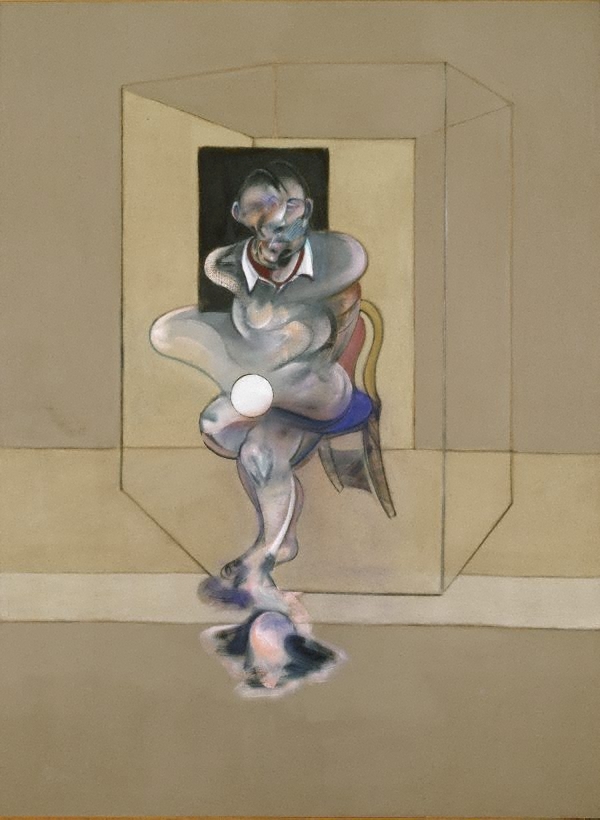
In 'Study for self-portrait' Bacon portrays himself, as in many of his portraits, contained within a geometric 'interior' form that evokes the trial of Nazi Adolf Eichmann in his courtroom glass cage.2 Isolated and imprisoned by the 'exterior' expanse of the canvas, Bacon lurches forward in a distorting and twisting spasm which doubles and blurs as if in constant motion, yet remains anchored to the chair. His aim in painting these disturbing and isolated figures was to distort into reality - not away from reality - to reveal the truth and the essence of the person rather than merely paint an illustration. Bacon argued that the only way to convey fact or truth was through a form of distortion, a distortion that reflected life's suffering and despair.3 Within the spasmodic event, the figure oozes and dissolves through the barrier of the containing form and splurges into the foreground. It is as if the body, in reaching the limit of the barrier, removes a part of itself from itself and thrusts it out in a frenzied attempt to escape the containing space. All that remains at the point of disjuncture is a circular void, the detached flesh already decaying in the empty field beyond him.
The contrast between the disrupted fleshiness of the body and the clean expanse of the colour field heightens the sense of physical abjection. The brute and raw nature of the figure represents in some ways what Bacon refers to as the dung heap of life. In this self-portrait Bacon looks on the world with a squeamish horror, his face doubled and blurred in his desire to capture the human scream of suffering.
1. Max Kozloff, 'Francis Bacon, 16 Nov 1963', 'Writing on art from the Nation: 1865-2001', Thunder's Mouth Press, New York 2001, p 307
2. The geometric form is the parallelepiped, a polyhedron with six faces that are parallelograms
3. See 'Francis Bacon: a retrospective', the Trust for Museum Exhibitions, New York 1999, p 8© Art Gallery of New South Wales Contemporary Collection Handbook, 2006
-
Video
-
Exhibition history
Shown in 11 exhibitions
Francis Bacon: oeuvres récentes, Galerie Claude Bernard, Paris, 19 Jan 1977–26 Mar 1977
Francis Bacon: works 1970-1977, Museo de Arte Moderno, Mexico City, Oct 1977–Dec 1977
Francis Bacon, Museo de Arte Contemporáneo de Caracas, Venezuela, Feb 1978–Feb 1978
Three years on: acquisitions 1978-81, Art Gallery of New South Wales, Sydney, 15 Oct 1981–01 Dec 1981
Francis Bacon, Palazzo Reale, Italy, 04 Mar 2008–24 Aug 2008
Francis Bacon: five decades, Art Gallery of New South Wales, Sydney, 17 Nov 2012–17 Feb 2013
Francis Bacon, The National Museum of Modern Art, Tokyo, Tokyo, 08 Mar 2013–26 May 2013
Francis Bacon, Toyota Municipal Museum of Art, Japan, 08 Jun 2013–01 Sep 2013
Francis Bacon, Monaco et le French Culture, Grimaldi Forum, Monaco, 01 Jul 2016–04 Sep 2016
Francis Bacon: de Picasso a Velázquez, Guggenheim Museum Bilbao, Spain, 30 Sep 2016–08 Jan 2017
Francis Bacon 1971 - 1992, Centre national d'art et de culture Georges Pompidou, France, 11 Sep 2019–20 Jan 2020
Francis Bacon 1971 - 1992, The Museum of Fine Arts, Houston, United States of America, 23 Feb 2020–16 Aug 2020
20th-Century galleries, ground level (rehang), Art Gallery of New South Wales, Sydney, 20 Aug 2022–2023
-
Bibliography
Referenced in 22 publications
-
Elvira Adelstein, Look, 'Francis Bacon portraying the human predicament', pg. 20-21, Heidelberg, Jun 1993, 20-21 (colour illus.).
-
Anthony Bond OAM (Curator), Francis Bacon: five decades, Sydney, 2012, 194, 195 (colour illus.), 235 (colour illus.).
-
Donna Brett, Contemporary: Art Gallery of New South Wales Contemporary Collection, 'Expression and the figure', pg.108-153, Sydney, 2006, 116, 117 (colour illus.).
-
René Free, Art Gallery of New South Wales handbook, 'European', pg. 36-56, Sydney, 1988, 56.
-
Renée Free, Three years on: a selection of acquisitions 1978-1981, 'European Art', pg. 27-36, Sydney, 1981, 33 (colour illus.). cat. no.2
-
Renee Free, Art and Australia, 'European Acquisitions: 1972-83', pg. 63-67, Sydney, Spring 1984, 64 (colour illus.), 67.
-
Renée Free, AGNSW Collections, 'The western heritage, Renaissance to twentieth century', pg. 108-172, Sydney, 1994, 172 (colour illus.).
-
Renée Free, Art Gallery of New South Wales catalogue of British paintings, Sydney, 1987, 10 (illus.), 11.
-
Galerie Claude Bernard, Francis Bacon: oeuvres récentes, Paris, 1977, (colour illus.). cat.no. 9
-
Martin Harrison, Francis Bacon: La France et Monaco, Monaco, 2016, (colour illus.).
-
Martin Harrison, Francis Bacon: de Picasso a Velázquez, Bilbao, 2016, 130, 131 (colour illus.). cat.no.49
-
Kenjiro Hosaka, Masuda Tomohiro and Suzuki Toshiharu (Curators), Francis Bacon, Tokyo, 2013, 88, 89 (colour illus.). cat.no.28, text in Japanese
-
Bruce James, Art Gallery of New South Wales handbook, 'Western Collection: Paintings and Sculpture', pg. 17-77, Sydney, 1999, 70 (colour illus.).
-
Anne Kirker and Peter Tomory, British painting 1800–1990 in Australian and New Zealand public collections, Sydney, 1997, 46. cat.no. 65
-
Clem Lloyd and Peter Sekuless, Australia's national collections, Sydney, 1980, 257 (colour illus.).
-
Museo de Arte Contemporáneo de Caracas, Francis Bacon, Caracas, 1978, (colour illus.). cat.no. 8. Used for poster for exhibition.
-
Museo de Arte Moderno, Francis Bacon: works 1970-1977, Mexico City, 1977, (illus.). cat.no. 9
-
Bernard Rigby, Look, 'Francis Bacon and the law of Entropy', pg. 17, Melbourne, Oct 1999, 17 (colour illus.).
-
The National Museum of Modern Art, Tokyo, Francis Bacon: paintings 1945-1982, Tokyo, 1983, 109.
-
Michael Wardell, Look, 'Mervyn Horton's bequest', pg. 11-12, Sydney, Jun 2004, 11.
-
Donald Williams and Barbara Vance Wilson, From caves to canvas: an introduction to western art, 'From the Inside: Abstract Expressionism', pg.249-262, Sydney, 1992, 259 (illus.).
-
Donald Williams and Barbara Vance Wilson, From caves to canvas: an introduction to western art (Second edition), 'From the inside: Abstract xxpressionism and new sculpture', pg.295-312, Sydney, 1998, 304, 305 (colour illus.).
-
 Video 2:18