


-
Details
- Place where the work was made
-
Japan
- Period
- Edo (Tokugawa) period 1615 - 1868 → Japan
- Date
- circa 1855
- Media categories
- Scroll , Painting
- Materials used
- hanging scroll; colour on silk
- Dimensions
- 127.0 x 55.4 cm image; 194.0 x 70.0 x 75.4 cm scroll
- Signature & date
Signed l.r., in Japanese, ink [inscribed] "Seisei Kiitsu" [and artist's seal]. Not dated.
- Credit
- Purchased 1983
- Location
- Not on display
- Accession number
- 205.1983
- Copyright
- Artist information
-
Suzuki Kiitsu
Works in the collection
- Share
-


-
About
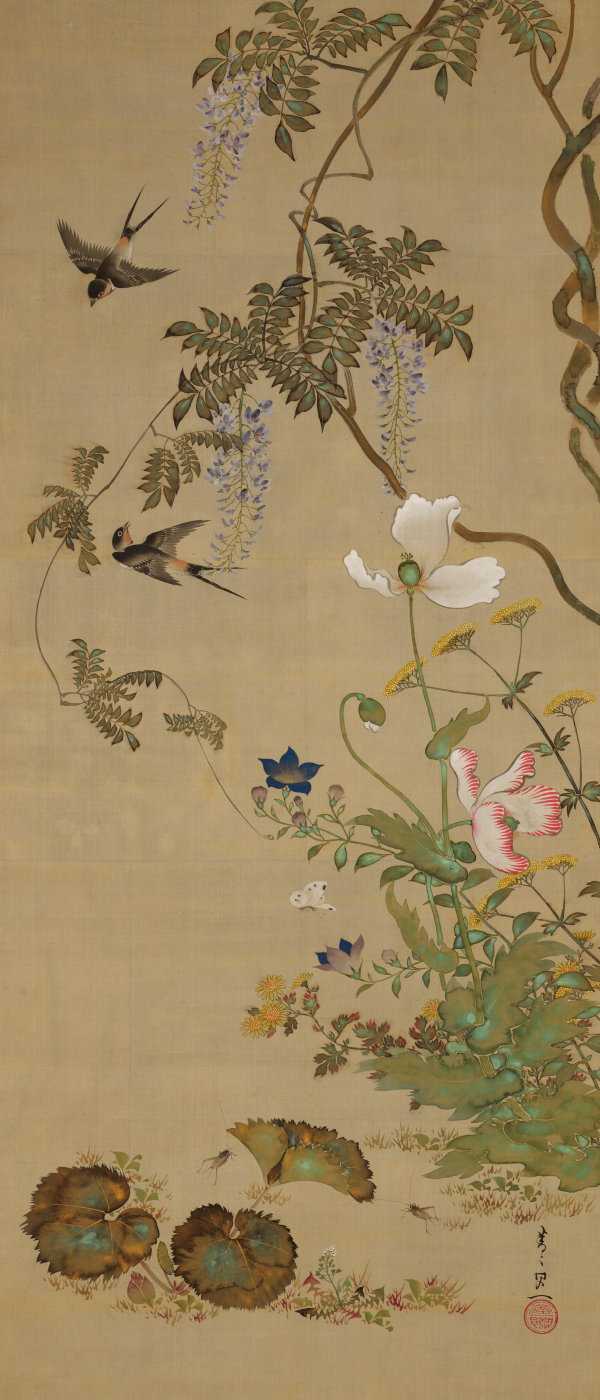
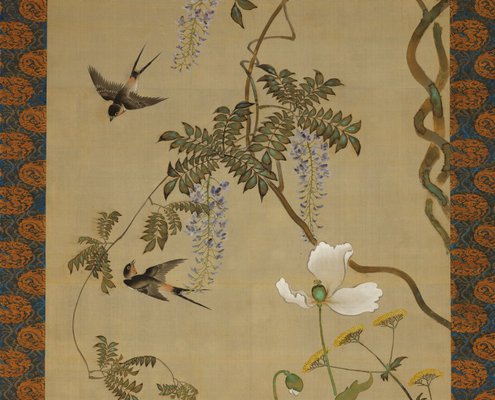
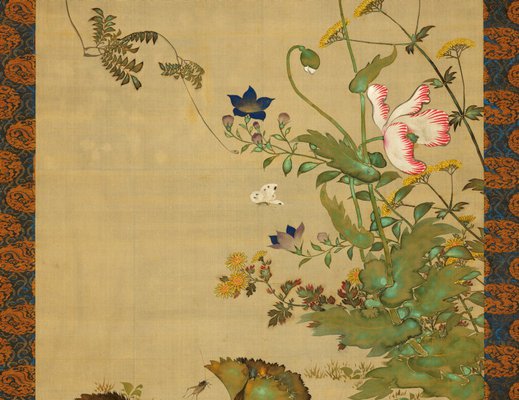
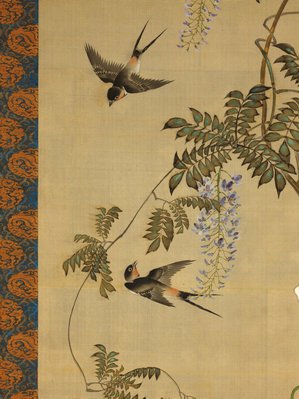
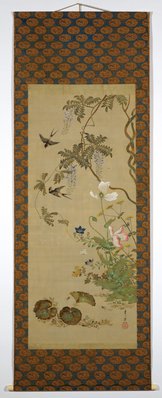
In this painting flowers of all seasons such as wisteria (spring), poppies (summer), bush clover and bellflower (autumn) are combined to celebrate a timeless world of flowers. However, the loss of petals on the poppy in the centre of the painting is an unmistakable sign of impermanence. Kiitsu Suzuki, a later Rinpa school artist, has used a characteristic Rinpa technique of dropping one colour onto another while still wet to create a suffused effect, known as 'tarashikomi'.
The Asian Collections, AGNSW, 2003, pg.232.
-
Places
Where the work was made
Japan
-
Exhibition history
Shown in 1 exhibition
Kamisaka Sekka - Dawn of modern Japanese design, Art Gallery of New South Wales, Sydney, 21 Jun 2012–26 Aug 2012
-
Bibliography
Referenced in 4 publications
-
Edmund Capon AM, OBE and Jan Meek (Editors), Portrait of a Gallery, 'Asian Art', pg. 106-113, Sydney, 1984, 112 (colour illus.).
-
Jackie Menzies (Editor), The Asian Collections Art Gallery of New South Wales, 'Edo Painting Schools', Sydney, 2003, 232-233 (colour illus.). The colour illus. on page 233 is a detail of this work.
-
Jill Sykes (Editor), Look, 'How Asian artists depict nature', pg. 29, Sydney, Mar 2002, 29 (colour illus.).
-
Khanh Trinh (Editor), Kamisaka Sekka: dawn of modern Japanese design, Sydney, 2012, 55 (colour illus.). cat.no. 23
-