Title
The swimmers, Milingimbi, Arnhem Land
1952
printed 1983
Artist

-
Details
- Dates
- 1952
printed 1983 - Media category
- Photograph
- Materials used
- gelatin silver photograph
- Dimensions
- 43.2 x 32.8 cm image; 50.5 x 40.4 cm sheet
- Signature & date
Signed l.r. sheet., pencil "Axel Poignant". Dated l.centre verso, pencil "...1952 /...1983
- Credit
- Purchased 1983
- Location
- Not on display
- Accession number
- 161.1983
- Copyright
- © Courtesy Roslyn Poignant
- Artist information
-
Axel Poignant
Works in the collection
- Share
-


-
About
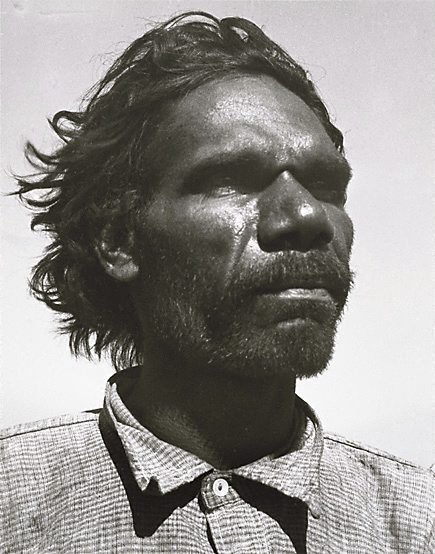
Axel Poignant, who migrated to Australia in 1926, felt he had been ‘re-born an Australian’ having witnessed the miraculous transformation of the desert when its transitory flowers and birdlife came to life after rain on the Canning Stock Route in Western Australia in 1942. There he developed an intense affinity with the landscape and Indigenous Australians whom he photographed. He said: ‘I was hooked … From this time I had a conscious commitment to the documentary in both still and movie photography.’1 Captivated by the land, the people and their cultures Poignant visited Nagalarramba and Milingimbi, Arnhem Land, in 1952 to record with dignity and humanity the traditional daily life of Aboriginal people which was under threat from the official policy of assimilation at the time.
Poignant’s image of children swimming at Milingimbi suggests they could spring to life in a series of moving frames as their exuberance almost leaps from the print itself. The composition of the children implies one movement as they run, jump and dive. Their arc-like shape mimics the partially submerged tree – both silhouetted against the vast water and sky. The joy of playing, swimming and splashing is a universal pastime for many children, and images such as ‘The swimmers, Milingimbi’ conveyed a humane understanding of Indigenous people to the wider Australian public. This concept was achieved when Poignant’s photo-story, ‘Piccaninny walkabout: a story of two Aboriginal children’, was published as a children’s book in 1957. Its popularity demanded further editions, with the book retitled ‘Bush walkabout’ by Poignant in 1972.
1. Gross J 1984, ‘Axel Poignant’, ‘The British Journal of Photography’, 84/26, 29 Jun
© Art Gallery of New South Wales Photography Collection Handbook, 2007
-
Exhibition history
Shown in 6 exhibitions
Five years on: a selection of acquisitions 1981-1986, Art Gallery of New South Wales, Sydney, 26 Sep 1986–23 Nov 1986
Four Photographers, Art Gallery of New South Wales, Sydney, 02 Jun 1990–19 Aug 1990
Fine and mostly sunny: photographs from the collection, Art Gallery of New South Wales, Sydney, 28 Sep 1991–01 Dec 1991
Waterproof - One Hundred Days Festival - Expo 98, Lisboa EXPO 98, Lisbon, 27 Feb 1998–31 May 1998
"When I was young...": artists' impressions of childhood, Global Arts Link, Ipswich, 09 Nov 2002–02 Feb 2003
6 photographers, Art Gallery of New South Wales, Sydney, 05 Dec 2009–Feb 2010
-
Bibliography
Referenced in 7 publications
-
Art Gallery of New South Wales, Five years on: a selection of acquisitions 1981-1986, Sydney, 1986. cat.no. 173
-
Jorge Calado, À Prova de Água Waterproof, Lisbon, 1998, (illus.). plate no. 145
-
Xavier Herbert, Capricornia, Sydney, Unknown, cover (illus.).
-
Bruce James, Art Gallery of New South Wales handbook, 'Australian Collection: Australian Photography', pg. 198-207, Sydney, 1999, 205 (illus.).
-
Elizabeth Maloney, Look, '6 photographers with attitude', pg.35, Sydney, Dec 2009-Jan 2010, 35 (illus.).
-
Ewen McDonald, AGNSW Collections, 'From Colonialism to late Modernism', pg. 7-106, Sydney, 1994, 61 (illus.).
-
Rose Peel, Photography: Art Gallery of New South Wales Collection, 'Australian postwar photo-documentary', pg.189-207, Sydney, 2007, 194, 200 (illus.).
-