Title
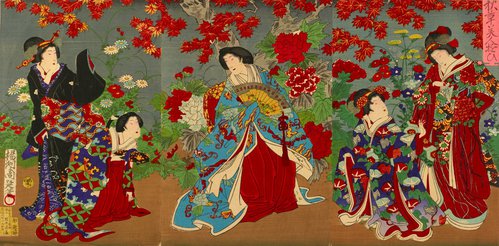
(Yoshitsune in the mountains), from the series The vicissitudes of the Minamoto and Taira clans
1885
Artist

-
Details
- Alternative title
- Genpei seisui ki:Jû-go
- Place where the work was made
-
Japan
- Period
- Meiji period 1868 - 1912 → Japan
- Date
- 1885
- Media category
- Materials used
- woodblock print; ink and colour on paper
- Dimensions
- 35.4 x 24.3 cm image; 37.3 x 25.0 cm sheet
- Signature & date
Signed c.r., in Japanese, ink "Yôshû Chikanobu hitsû [and artist's seal]". Not dated.
- Credit
- Gift of Dr Roderick Bain 1997
- Location
- Not on display
- Accession number
- 160.1997
- Copyright
- Artist information
-
Toyohara (Yōshū) Chikanobu
Works in the collection
- Share
-


-
About
Produced in the mid to late 19th century, the period often referred to as the 'decadent' period of ukiyo-e, the subject matter reflects the feeling of unrest in Japan when the Shogunate Government was losing its grip on the rising powers of merchants & progressive regions. The subtlety of the pleasure seeking 'floating world' of earlier times gave way to depictions of emotional drama or violence taken from historical battles, stories of heroic deeds & the kabuki theatre.
Text inscription in work reads: 'Yoshitsune left Yoshino and hid in the Capital to track the enemy movements. Perceiving danger, he decided to go to the north and seek protection the of (Fujiwara) Hidehira, and gathered his men in his wife's hideaway in Imagawa, Kyoto. Having agreed on the plan, the party disguised themselves as mountain monks. Yoshitsune's wife insisted on following him, so he took her and his baby with him.'
-
Places
Where the work was made
Japan
-
Exhibition history
Shown in 2 exhibitions
Heroes and Villains, Art Gallery of New South Wales, Sydney, 19 May 2001–19 Aug 2001
Conversations through the Asian collections, Art Gallery of New South Wales, Sydney, 25 Oct 2014–13 Mar 2016
-
Bibliography
Referenced in 1 publication
-
AJIOKA Chiaki (Curator), Heroes and villains: from Japan's floating world, Sydney, May 2001, 6. cat.no. 1.5
-