

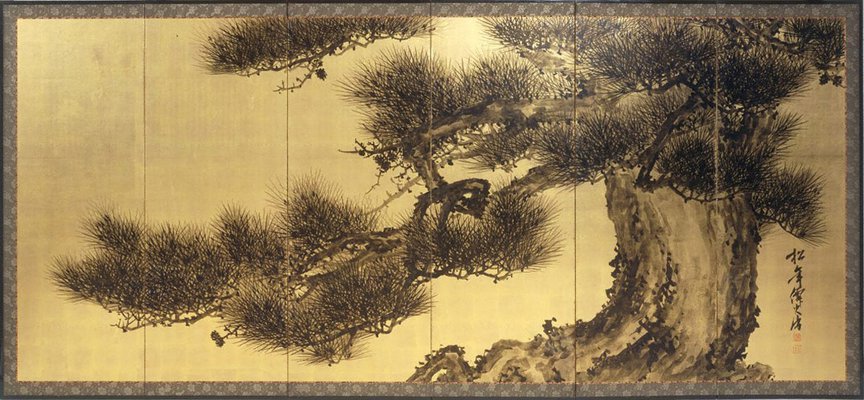
-
Details
- Place where the work was made
-
Japan
- Period
- Meiji period 1868 - 1912 → Japan
- Date
- 19th century-20th century
- Media categories
- Screen , Painting
- Materials used
- pair of six-panel screens; ink on gilded paper
- Dimensions
-
a - right panel - text at right, 153 x 364 cm
a - right panel - text at right, 168.9 x 367.4 cm
b - left panel - text at left, 153 x 364 cm
b - left panel - text at left, 168.9 x 367.4 cm
- Signature & date
Signed l.r. of right screen in Japanese, stamped in red ink, "[two artist's seals]". Not dated.
Signed l.l. of left screen in Japanese, stamped in red ink, "[two artist's seals]". Not dated.- Credit
- Purchased 2000
- Location
- Not on display
- Accession number
- 15.2000.a-b
- Copyright
- Artist information
-
Suzuki Shōnen
Works in the collection
- Share
-


-
About
Suzuki Shônen was born in Kyoto as son of Suzuki Hyakunen (1825-1891) who established his own style of painting without adhering to any of the established styles such as the Shijô-Maruyama, nanga or Kanô schools. Shônen is considered the best student of Hyakunen's, and was known for his bold and dramatic brushstrokes. From 1881 to 1888 Shônen was the head of the Northern Division (ink painting in the Sesshû tradition) of the Kyoto Prefecture Painting School (other divisions were: South - nanga school; East - Shijô-Maruyama school; and West - Western style painting).
Shônen appears to have been satisfied with cultivating his own art on the eve of sweeping modernisation in Japanese painting, which, in Kyoto, was led by Takeuchi Seihô, a pupil of Shônen's rival and a Shijô artist Kôno Bairei.
Thus his name is less often associated with the modern movements of Japanese painting than with Uemura Shôen, one of his most talented students and the most prominent female painter of the Meiji period.
Shônen is known for his powerful brushstrokes, as demonstrated in this spectacular pair of screens, on which he depicted the pine tree, a symbol of strength, with the unfettered spirit of the progressive Meiji era.
Asian Art Dept, AGNSW, February 2000.
-
Places
Where the work was made
Japan
-
Exhibition history
Shown in 1 exhibition
The art of Japanese screen painting, Art Gallery of New South Wales, Sydney, 06 Nov 2004–06 Feb 2005
-
Bibliography
Referenced in 1 publication
-
Jackie Menzies (Editor), The Asian Collections Art Gallery of New South Wales, 'A New Dichotomy', Sydney, 2003, 274-275 (colour illus.). The colour illus. on page 275 is a detail of this work.
-