Title
Altar vase
late 18th century
Artists
Unknown Artist
-
Details
- Place where the work was made
-
China
- Period
- Jiaqing 1796 - 1820 → Qing dynasty 1644 - 1911 → China
- Date
- late 18th century
- Media category
- Ceramic
- Materials used
- porcelain with overglazed enamels on yellow ground
- Dimensions
- 25.4 x 15.5 cm
- Credit
- Gift of Mr J.H. Myrtle 1991
- Location
- Not on display
- Accession number
- 148.1991
- Copyright
- Share
-


-
About
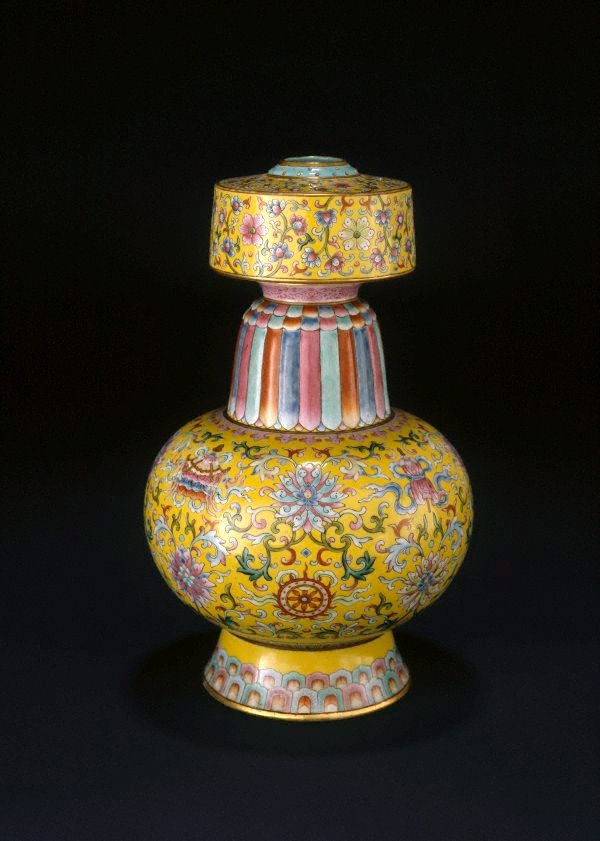
This skilfully modelled vase, with a shape inspired by Tibetan metal prototypes and a complexity of decoration typical of late Qing dynasty Imperial porcelain, was used on altars in the Imperial palace. The main decoration comprises eight lotus blooms and the eight Buddhist emblems of Happy Augury ('baji xiang'). The eight Buddhist emblems, popular motifs in Chinese decoration, are the canopy, the royal umbrella, the conch shell, the vase, the wheel of the law, the endless knot, the lotus flower and the pair of fish.
'Asian Art', AGNSW Collections, 1994, pg. 205.
-
Places
Where the work was made
China
-
Exhibition history
Shown in 5 exhibitions
Late Chinese Imperial Porcelain, Art Gallery of New South Wales, Sydney, 02 Aug 1980–21 Sep 1980
Great gifts, great patrons, Art Gallery of New South Wales, Sydney, 17 Aug 1994–19 Oct 1994
Buddhist Art from the Collection of the Art Gallery of New South Wales, Art Gallery of New South Wales, Sydney, 06 May 1995–10 Sep 1995
Conversations through the Asian collections, Art Gallery of New South Wales, Sydney, 25 Oct 2014–13 Mar 2016
Glorious, Art Gallery of New South Wales, Sydney, 27 May 2017–06 Jan 2019
-
Bibliography
Referenced in 2 publications
-
J. Hepburn Myrtle, Late Chinese Imperial Porcelain, Sydney, 1980, 14 (illus.). cat.no. 10
-
Jackie Menzies, AGNSW Collections, 'Asian Art - India, South-East Asia, China, Tibet, Korea, Japan', pg. 173-228, Sydney, 1994, 205 (colour illus.).
-