Title
Narodakini
20th century
Artists
Unknown Artist
-
Details
- Other Title
- Vajravarahi
- Alternative title
- Vajrayogini
- Place where the work was made
-
Tibet
- Date
- 20th century
- Media category
- Sculpture
- Materials used
- parcel gilt and inlaid silver bronze
- Dimensions
- 86.2 x 66.8 x 26.2 cm
- Signature & date
Not signed. Not dated.
- Credit
- Gift of JA and HD Sperling 2000
- Location
- South Building, lower level 1, Asian Lantern galleries
- Accession number
- 140.2000
- Copyright
- Share
-


-
About
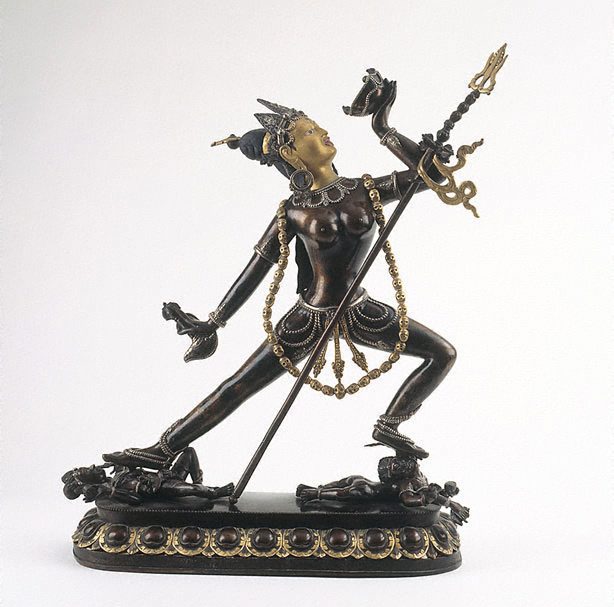
Another epiphany of Vajrayogini that was introduced in India and remains important in contemporary Tibetan practice is Narodakini or Naro Khachoma, readily recognisable by her lunging posture and raised skull bowl. Narodakini is so named because her practice lineages stem from Naropa, the Indian adept to whom she revealed herself in this form. Apart from her distinctive pose, Narodakini shares most of the symbolic attributes and emblems of Tantric female Buddhas discussed in relation to Vajravarahi (p. 203). Another notable difference is that whereas Vajravarahi has an upward-streaming mane, Narodakini has long, unbound tresses. Freely flowing hair is in the Indic setting a mark of a yogic practitioner, especially one who practices Tantra. Buddhist interpreters add another layer of meaning, holding that her untamed tresses signify that her mind is free from all selfishness and attachments and hence flows freely in a state of joyful communion with present reality. Narodakini’s upturned face is poised to drink the nectar of bliss that perpetually flows from her skull cup. She is also said to be gazing toward her Buddha paradise, known as Khechara, ‘Sky-Pleasure’, where those who successfully traverse the Tantric path will ascend at the end of their earthly life and live eternally in her presence in her realm of heavenly splendour and beauty. Upon attaining Buddhahood in her enlightening presence, they can generate their own Buddha-bodies and traverse the universe to guide others to liberation.
[Note: Narodakini is often mistakenly identified as Sarvabuddhadakini or Vajradakini. These latter terms, however, are epithets that are used for all forms of Vajrayogini rather than designations of a specific epiphany.]
Miranda Shaw, ‘Goddess: divine energy’, pg.206.
© 2006 Art Gallery of New South Wales -
Places
Where the work was made
Tibet
-
Exhibition history
Shown in 4 exhibitions
Goddess: Divine Energy, Art Gallery of New South Wales, Sydney, 13 Oct 2006–28 Jan 2007
Conversations through the Asian collections, Art Gallery of New South Wales, Sydney, 25 Oct 2014–13 Mar 2016
Archie Plus, Art Gallery of New South Wales, Sydney, 26 Sep 2020–07 Mar 2021
Elemental, Art Gallery of New South Wales, Sydney, 30 Jul 2022–2024
-
Bibliography
Referenced in 5 publications
-
Chaya Chandrasekhar, TAASA Review, 'Sacred Symbol, Secret Meeting: the 'Khatvanga' Ritual Staff in Buddhism', pg. 6-8, Sydney, Mar 2006, 6 (colour illus.).
-
Miranda Shaw, Goddess: Divine Energy, 'Dharani goddesses and female Buddhas', pg. 193-209, Sydney, 2006, 206 (colour illus.). cat.no. 129.
-
Susannah Smith (Editor), Look, Sydney, Oct 2022-Nov 2022, 14 (colour illus.).
-
Jill Sykes, Look, 'Buddha rules', pg. 13, Melbourne, Sep 2001, 13 (colour illus.).
-
Jill Sykes (Editor), Look, Sydney, Dec 2003-Jan 2004, 9 (colour illus.).
-
-
Provenance
Mr Hal & Mrs Judith Sperling, pre May 2000, Sydney/New South Wales/Australia, donated to the Art Gallery of New South Wales, Sydney, May 2000.