Title
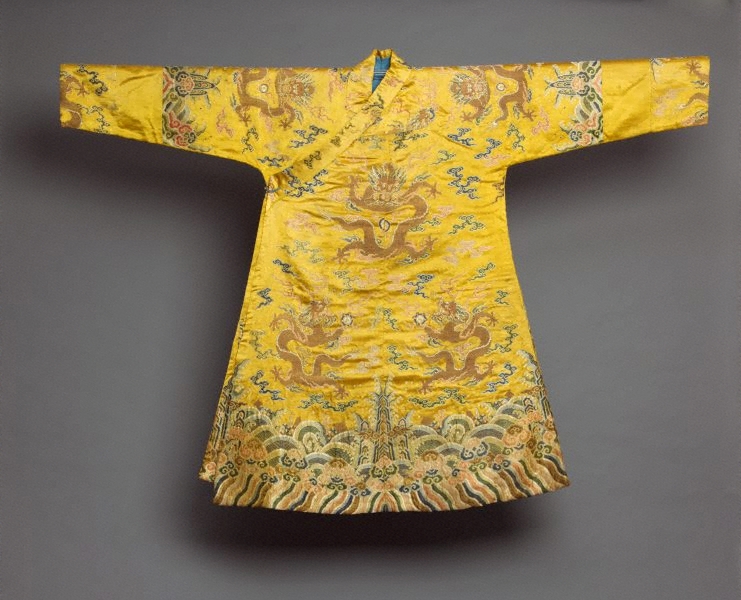
Chuba with dragon design
18th century
Artists
Unknown Artist

-
Details
- Other Title
- Dragon robe (Tibetan 'chuba')
- Place where the work was made
-
China
- Date
- 18th century
- Media category
- Textile
- Materials used
- yellow silk brocade
- Dimensions
- 135.8 x 187.4 cm
- Signature & date
Not signed. Not dated.
- Credit
- Edward and Goldie Sternberg Chinese art purchase fund 2000
- Location
- Not on display
- Accession number
- 137.2000
- Copyright
- Share
-


-
About
This magnificent Tibetan 'chuba', or 'ji fu' (auspicious cloth), was tailored from 18th century Chinese 'kesi' (or woven tapestry) silk brocade probably woven in the Cloud Brocade Institute in Nanjing. During the Yuan, Ming and Qing dynasties, successive Mongol, Chinese and Manchu emperors patronised important Tibetan Buddhist monasteries and abbots with lavish gifts, including silks. As Tibetans did not produce silk, they particularly welcomed such gifts of luxurious silk textiles from the Chinese court. These gifts were then re-tailored in Tibetan styles or re-used to decorate temple buildings. Until the present century, many of the leading Tibetan Buddhist lamas such as the Dalai and Panchen Lamas would wear elaborately decorated 'chuba' on state occasions.
This robe features eight five-claw dragons, three on the front, three on the back, and one on each sleeve. The creatures float in the cosmic setting represented by the mountains (the earth), waves (the sea), and the clouds (the sky). The five colours of the auspicious clouds, white, blue, black, red and yellow represent the five elements of Metal, Wood, Water, Fire and Earth in the Chinese philosophy of the universe.
Asian Art Department, AGNSW, January 2012
-
Places
Where the work was made
China
-
Exhibition history
Shown in 4 exhibitions
Celestial silks: Chinese religious & court textiles, Art Gallery of New South Wales, Sydney, 31 Jul 2004–24 Oct 2004
Dragon (2012), Art Gallery of New South Wales, Sydney, 18 Jan 2012–06 May 2012
The connoisseur and the philanthropist: 30 years of the Sternberg Collection of Chinese Art, Art Gallery of New South Wales, Sydney, 31 Jan 2014–27 Apr 2014
Glorious, Art Gallery of New South Wales, Sydney, 27 May 2017–06 Jan 2019
-
Bibliography
Referenced in 2 publications
-
Judith Rutherford, Arts of Asia, 'Celestial Silks', pg. 33-46, Hong Kong, Jul 2003-Aug 2004, 37 (colour illus.).
-
Judith Rutherford and Jackie Menzies (Editors), Celestial silks: Chinese religious & court textiles, Sydney, 2004, 43 (colour illus.). cat.no. 17
-