-
Details
- Other Title
- Woolloomooloo (night)
- Place where the work was made
-
Woolloomooloo
→
Sydney
→
New South Wales
→
Australia
- Date
- 2004
- Media categories
- Time-based art , Installation
- Materials used
- single channel digital video, colour, sound
- Edition
- 3/4
- Dimensions
- duration: 00:25:40 min, aspect ratio: 16:9
- Signature & date
Signed l.c. certificate of authenticity, black fibre-tipped pen "Shaun Gladwell". Not dated.
- Credit
- Purchased with funds provided by the Contemporary Collection Benefactors 2005
- Location
- Not on display
- Accession number
- 129.2005
- Copyright
- © Shaun Gladwell
- Artist information
-
Shaun Gladwell
Works in the collection
- Share
-


-
About
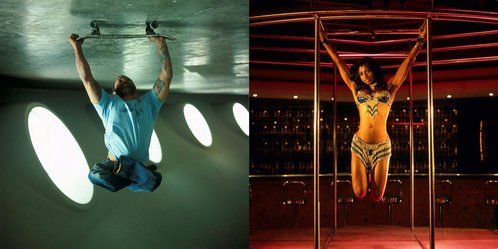
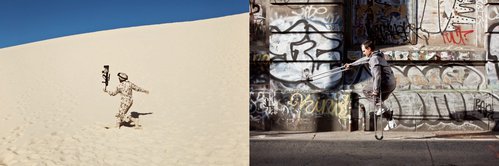
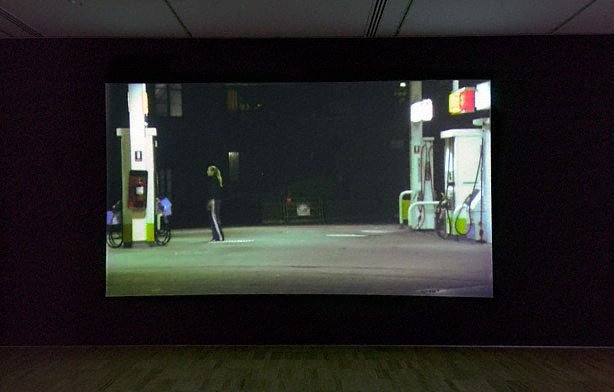
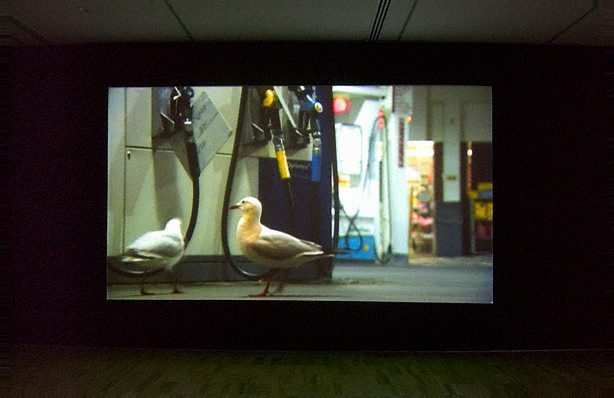
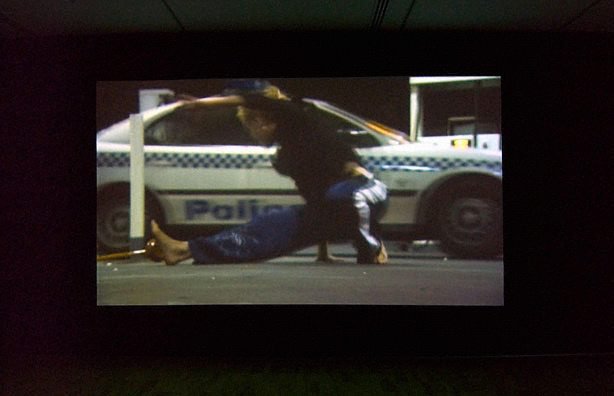
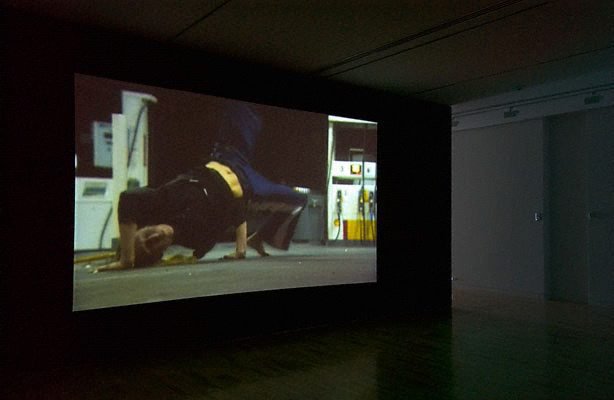
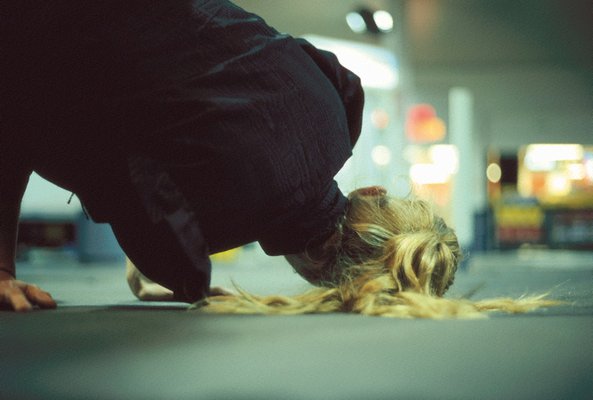
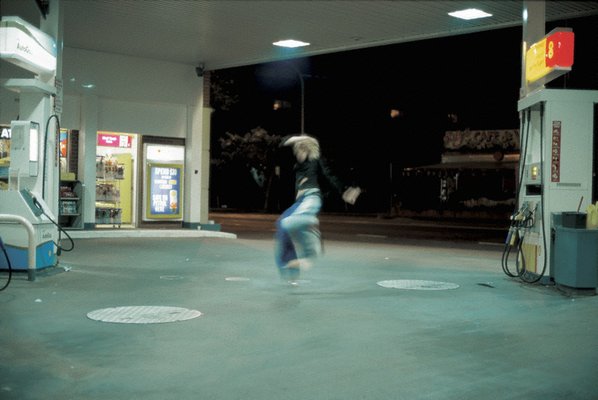
Shaun Gladwell’s videos focus on how his subjects move; breakdancers, skateboarders, roller-bladers, BMX bike riders are filmed on the streets and in urban public spaces such as parks, train stations and malls. Gladwell is himself a skateboarder and he creates a mesmerising dialogue between performance and street culture. ‘Woolloomooloo (night)’ was filmed in a service station near the AGNSW. Emma Magenta, a capoeira dancer, spins, twists and lunges in slow motion on the forecourt near the petrol pumps. Both a dance and a martial art, capoeira is thought to have been developed by African slaves in Brazil as a means of disguising self-defensive skills and fighting techniques. Combining strength, flexibility, balletic grace and razor-sharp timing, the dancing, spinning kicks and head lunges change rapidly from defensive to aggressive, with trickiness being particularly prized.
The capoeirista in Gladwell’s video negotiates the space of the service station, using it as stage rather than backdrop. The video has been slowed down, enabling the detail of her movements to be clearly seen, both demystifying the often rapid action of capoeira but also increasing our respect for the skill involved. The video moves from close-ups of Magenta to wide shots of the empty space around her, and her isolated figure seems to both embrace and react against this solitude. The slow speed and Kazumichi Grimes’ atmospheric soundtrack contribute to an elegiac mood, drawing attention to the haunting imagery of the lone figure moving through the empty forecourt.
Gladwell has slowed time in many of his videos, deliberately working against the real-time recording inherent in video documentation. In ‘Storm sequence’ 2000 the skateboarder gracefully executing kicks and flips in front of an approaching storm was reduced to a balletic pace. In ‘Godspeed verticals’ 2004, a breakdancer slowly ascends an escalator, dances and then descends back into a train station. Time slowed in films usually implies that the particular scene needs scrutiny beyond narrative speed: the slowness can be poetic, emphasising certain images, objects or human relations, and it is often tragic, allowing the full import of an event to unfold. Perhaps most importantly the warping of time adds another dimension to what we are witnessing, particularly as it frees visual narrative from realist demands. Against the accelerated time and speed so often associated with contemporary urban life, Gladwell pauses, slows and presents another version of time as he films creative temporary interventions into the functional rationalism of generic public spaces.
-
Exhibition history
Shown in 4 exhibitions
Anne Landa Award for video and new media arts, Art Gallery of New South Wales, Sydney, 02 Dec 2004–13 Feb 2005
Collection+: Shaun Gladwell, Galleries UNSW, Paddington, 06 Mar 2015–25 Apr 2015
Shaun Gladwell, Museum of Contemporary Art, Australia, 19 Jul 2019–07 Oct 2019
Local Rhythms and Actions, Art Gallery of New South Wales, Sydney, 04 Jun 2022–08 Jan 2023
-
Bibliography
Referenced in 10 publications
-
David Broker, Streetworks: inside outside Yokohama, Streetworks- inside outside Yokohama', pg. 9-17, Parkville, 2005, 6-7 (colour illus., video still), 15, 35.
-
Blair French, Shaun Gladwell: videowork, ‘Return to earth’, pg. 8-31, 2007, 9, 19, 23, 30, 36, 48, 72 (colour illus., video still), 73 (colour illus., video still), 108.
-
Stephen Hepworth, Shaun Gladwell: perpetual 360° sessions, ‘Extracts from the diary of a wanderer’, pg. 7-13, Heerlen, 2011, 7, 48 (colour illus., video still), 49 (colour illus., video still).
-
John Kaldor, Art and Australia (Vol. 42, No. 4), 'Gallery: eight contemporary Australian artists' selected, pg. 562-571, Sydney, Jun 2005-Aug 2005, 569 (colour illus., video still).
-
Simon Rees., Shaun Gladwell: various rolls, ‘Shaun Gladwell and the art of extreme makeovers’, Brisbane, Mar 2005, (colour illus., video still). not paginated
-
Michael Reid, The Sydney Morning Herald, ‘Showcasing the best of Australian art, with an eye to artistic merit and market value’, pg. 13, Sydney, 14 May 2005, 13 (colour illus., video still). Good weekend supplement; 'The art oracle'.
-
Michael Stutchbury (Editor), Weekend Australian Magazine, Canberra, 14 May 2003-15 May 2003, 13.
-
Wayne Tunnicliffe, Contemporary: Art Gallery of New South Wales Contemporary Collection, 'Reality bytes', pg. 382-423, Sydney, 2006, 402, 403 (colour illus., video still).
-
Wayne Tunnicliffe, Anne Landa Award for video and new media arts selected by Edmund Capon, Juliana Engberg, Wayne Tunnicliffe, Sydney, 2004, 16, 18-19, 20-21.
-
Sarah Tutton., Shaun Gladwell: stereo sequences, 'Shaun Gladwell: stereo sequences', Melbourne, 2011. not paginated
-