

-
Details
- Date
- 2003-2004
- Media category
- Sculpture
- Materials used
- laminated Jelutong, maple
- Dimensions
- 108.0 x 184.0 x 118.0 cm (irreg.)
- Credit
- Purchased with funds provided by the Rudy Komon Memorial Fund and the Contemporary Collection Benefactors 2004
- Location
- Not on display
- Accession number
- 125.2004
- Copyright
- © Ricky Swallow. Courtesy Darren Knight Gallery, Sydney
- Artist information
-
Ricky Swallow
Works in the collection
- Share
-


-
About
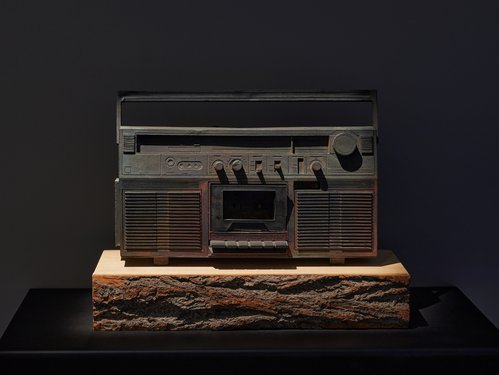
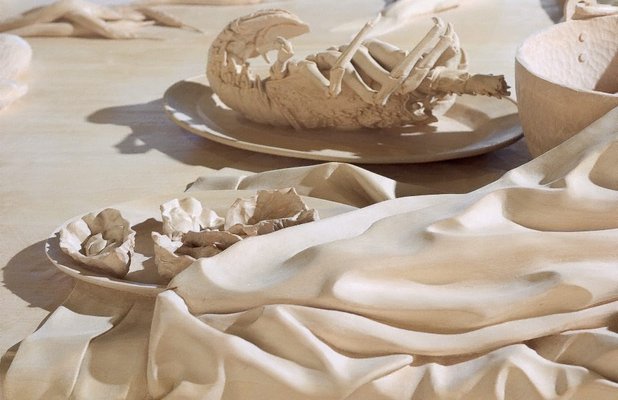
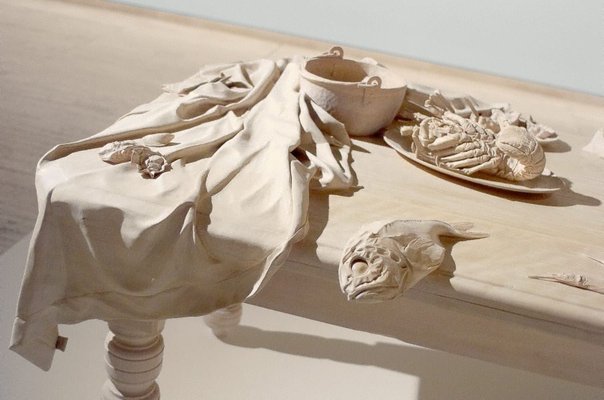
In 'Killing time' Ricky Swallow has synthesised his interests in time passing, personal and collective memory, everyday experiences and the history of art. Swallow's earlier sculptures were often carefully crafted duplicates of recently retro items, such as beatboxes and BMX bikes, or reworked record turntables with scaled-down narrative scenarios that blend science fiction and scientific fact. More recently he has made carvings of the animate and inanimate conceived and realised at a ratio of 1:1. 'Killing time' is the most ambitious work that Swallow has made to date and is likely to remain so for some time due to the onerous and time-consuming physical task of working in such detail on this scale. It was the centrepiece of Swallow's solo exhibition at the Australian Pavilion in the 2005 Venice Biennale.
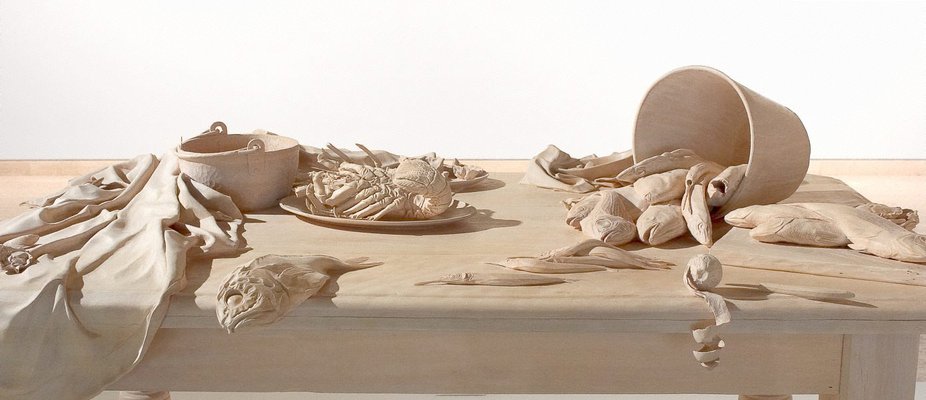
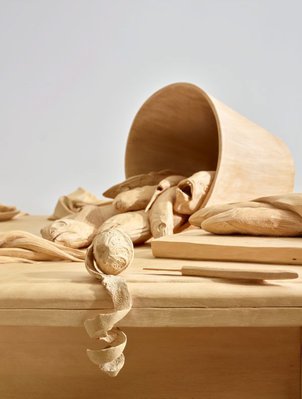
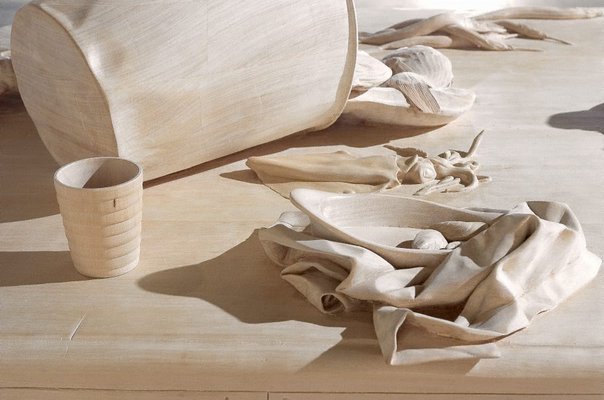
While 'Killing time' visually recalls 17th-century Dutch still-life painting and even the work of such a virtuoso illusionist woodcarver as Grinling Gibbons, the subject matter is derived from Swallow’s personal experience. The son of a fisherman, he has faithfully depicted every sea creature that he recalls capturing, killing and eating during his life. The various fish, lobsters, oysters, crabs and others are displayed on a table which duplicates the table around which Swallow’s family ate dinner. While 'Killing time' uses the visual language of a particular genre of painting and wood-carving, it is also an intensely personal act of remembering; it is another 'evaporated self-portrait' as Swallow has described his sculptures, which call on specific personal memories while also having a commonly recognisable subject matter.
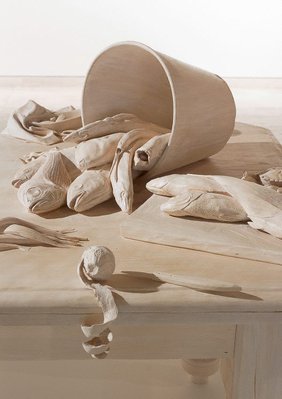
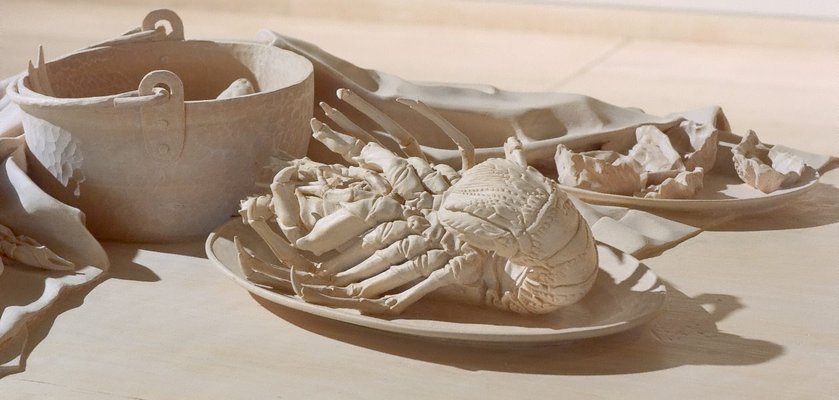
'Killing time' is carved mainly from laminated jelutong, a pale coloured hardwood used commercially for prototypes and pattern-making but also by woodworking hobbyists for whittling. The illusionism of the sculpture is emphasised by the attention to detail in the lobster, the lemon peel that hangs over the edge of the table and the rippling folds of the tablecloth pushed to one end. However the monochromatic timber and the dramatic side-lighting, devised by Swallow to create strong shadows and highlights, point to the inherent unreality of transcribing animate form into inanimate materials. There is a loop of commemoration and death that permeates this work, both in the references to the still-life genre and in the fact that the sculptor killed these creatures in the first place, long before carving this de facto memorial. In the 17th century, vanitas still-life paintings portrayed the abundance of natural life and worldly goods to celebrate this abundance while pointing to the fact that it was only transient, just as life itself is. The title 'Killing time' refers to this sense of life stilled in art, to the act of remembering and recording something from the artist’s past, and to the time spent on carving this labour-intensive sculpture.
© Art Gallery of New South Wales Contemporary Collection Handbook, 2006
-
Audio
Killing Time - Ricky Swallow 1:13
-
Exhibition history
Shown in 8 exhibitions
Killing Time, Darren Knight Gallery, Waterloo, 24 Feb 2004–20 Mar 2004
Killing Time, Gertrude Contemporary, Fitzroy, 02 Apr 2004–01 May 2004
This time another year: Venice Biennale 2005, Australian Pavilion, Venice Biennale, Venice, 12 Jun 2005–06 Nov 2005
Ricky Swallow, P.S.1, New York, 19 Jan 2006–20 Mar 2006
Ricky Swallow: The Bricoleur, Ian Potter Centre: NGV Australia, Melbourne, 15 Oct 2009–28 Feb 2010
21st century: art in the first decade, Queensland Art Gallery/Gallery of Modern Art, Brisbane, 18 Dec 2010–26 Apr 2011
Still life, Art Gallery of New South Wales, Sydney, 27 Jul 2013–23 Apr 2014
Beyond Belief: the Sublime in Contemporary Art, Bathurst Regional Art Gallery, Bathurst, 31 Mar 2017–04 Jun 2017
Obsession: devil in the detail, Mornington Peninsula Regional Gallery, Mornington, 30 Nov 2018–17 Feb 2019
-
Bibliography
Referenced in 16 publications
-
Pilar Arevalo, Oyster, 'Personal history' interview, pg. 52-55, Sydney, Apr 2004-May 2004, 53-55 (colour illus.). illustrations on pages 53 and 54 are details
-
Alex Baker, Ricky Swallow: the bricoleur, 'Ricky Swallow: the bricoleur', pg. 17-29, 2009, 42-43 (colour illus.).
-
Fiona Barbouttis, Foundation Newsletter #24, 'CCB comes of age', pg. 6-7, Sydney, Jul 2014, 6, 7 (colour illus.).
-
Klaus Biesenbach, Art and Australia (Vol. 42, No. 4), 'Panem et circenses: Ricky Swallow in Venice', pg. 572-9, Sydney, Jun 2005-Aug 2005, 572-3 (colour illus.), 579. illustration is a detail
-
Sarah Couper, Look, 'A place where stories are found', pg. 34-35, Sydney, Jun 2015, 34 (colour illus., detail), 35.
-
Peter Hill, The Sydney Morning Herald, 'Behold the man', pg. 9, Sydney, 06 Mar 2004-07 Mar 2004, 9 (colour illus.). Spectrum section
-
Stuart Koop, Beep ... crackle: contemporary art from the middle of nowhere, 'Ricky Swallow', pg. 146-155, Fortitude Valley, 2008, 147,152-153 (colour illus.).
-
Danny Lacy (Curator), Obsession: devil in the detail, 2018, 58 (detail (colour illus.), 71, 76-77 (colour illus.), 91.
-
Anne Loxley., The Sydney Morning Herald, 'Enticing feast for the eyes', Sydney, 09 Mar 2004, (colour illus.). illustration is a detail
-
Susan McCulloch, Alan McCulloch and Emily McCulloch Childs, The new McCulloch's encyclopedia of Australian art, Carlton, 2006, 931 (colour illus.).
-
Lisa-Marie Murphy, Look, 'Building the Gallery's collection', pg. 33-34, Sydney, Mar 2015, 34.
-
Justin Paton, Ricky Swallow - Killing Time, 2004, (colour illus.).
-
Wayne Tunnicliffe, Look, 'Exciting new purchase', pg. 33, Sydney, Dec 2004-Jan 2005, 33 (colour illus.). illustrations are details
-
Wayne Tunnicliffe, Contemporary: Art Gallery of New South Wales Contemporary Collection, 'Reality bytes', pg. 382-423, Sydney, 2006, 418-9 (colour illus.). illustration on pg.419 is a detail
-
Jade Williamson, Look, 'Brought to light: still life from the Australian collection', pg. 22-23, Sydney, Sep 2013, 22.
-
Andrew Yip, Look, 'Killing time in the house of Martha and Mary', pg. 18-19, Sydney, Aug 2012, 18 (colour illus., detail), 19 (colour illus.).
-