Title
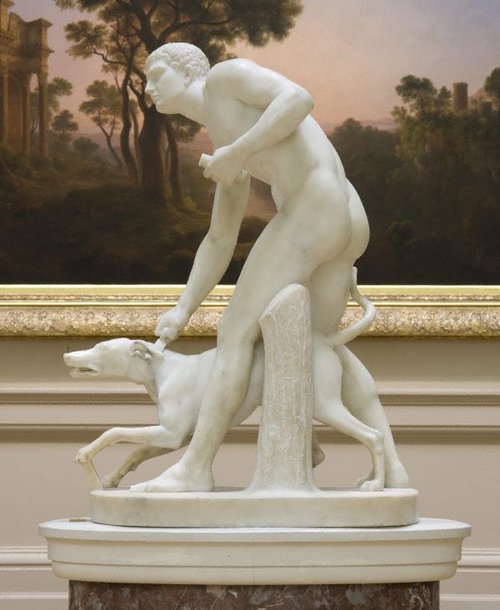
Narcissus
post 1829
Artist

-
Details
- Date
- post 1829
- Media category
- Sculpture
- Materials used
- marble
- Dimensions
- 86.0 x 36.0 x 60.0 cm
- Signature & date
Signed front of base [incised into marble], "I. GIBSON...". Not dated.
- Credit
- Purchased 1892
- Location
- Not on display
- Accession number
- 1220
- Copyright
- Artist information
-
John Gibson
Works in the collection
- Share
-


-
About
A protege of John Flaxman, John Gibson gravitated to Rome in 1818, becoming a pupil of the grandest of all neoclassical sculptors, Antonio Canova. Gibson's style was determined by his admiration for, and emulation of, the prototypical masterpieces of Greek and Roman statuary. A resulting academic quality, perfectly in accord with contemporary expectations of taste, became his sculptural signature. Though he experimented on occasion with polychromatic techniques and unusual materials, Gibson's preferred medium was marble, with its traditional associations of purity and chasteness. In this version of the Narcissus legend, inspired by a Roman youth gazing into a fountain, the sculptor transformed an everyday sight into a vision of antiquity. The subject's hairstyle and footwear are dutifully quoted from classical sources.
AGNSW Handbook, 1999 .
-
Exhibition history
Shown in 2 exhibitions
Regency - British Art & Design 1800-1830, Art Gallery of South Australia, Adelaide, 08 Apr 1998–14 Jun 1998
Archie Plus, Art Gallery of New South Wales, Sydney, 26 Sep 2020–07 Mar 2021
-
Bibliography
Referenced in 9 publications
-
Lady Elizabeth Eastlake, Life of John Gibson R.A., Sculptor, London, 1870.
-
Hans Fletcher, John Gibson's Narcissus, Unknown.
-
Renée Free, Art Gallery of New South Wales handbook, 'European', pg. 36-56, Sydney, 1988, 39.
-
Rupert Gunnis, Dictionary of British Sculptors 1660-1851, London, 1953, 161 (illus.).
-
Ruth Iredale., Look, 'From Monuments to Modernity', Heidelberg, Jul 1986.
-
Ruth Iredale., AGNSW Collections, 'From Monuments to Modernity', Sydney, 1994, 128, 129 (colour illus.).
-
Bruce James, Art Gallery of New South Wales handbook, 'Western Collection: Paintings and Sculpture', pg. 17-77, Sydney, 1999, 34 (colour illus.).
-
T. Matthews, The biography of John Gibson, R.A. Sculptor, Rome, London, 1911, 82.
-
Christopher Menz, Regency - British Art & Design 1800-1830, Adelaide, 1998, 82 (colour illus.). cat.no. 155
-