-
Details
- Place where the work was made
-
Japan
- Period
- Edo (Tokugawa) period 1615 - 1868 → Japan
- Date
- 18th century
- Media categories
- Screen , Painting
- Materials used
- single two-panel screen; ink, gold and silver on paper
- Dimensions
- 168.0 x 184.0 cm image; 172.5 x 188.4 cm screen
- Signature & date
Signed l.l., in Japanese, ink "[artist's seal]". Not dated. [left screen]
Signed l.r., in Japanese, ink "[artist's seal]". Not dated. [right screen]- Credit
- Purchased with funds provided by Kenneth Myer 1990
- Location
- Not on display
- Accession number
- 105.1990
- Copyright
- Artist information
-
Watanabe Shikō
Works in the collection
- Share
-


-
About
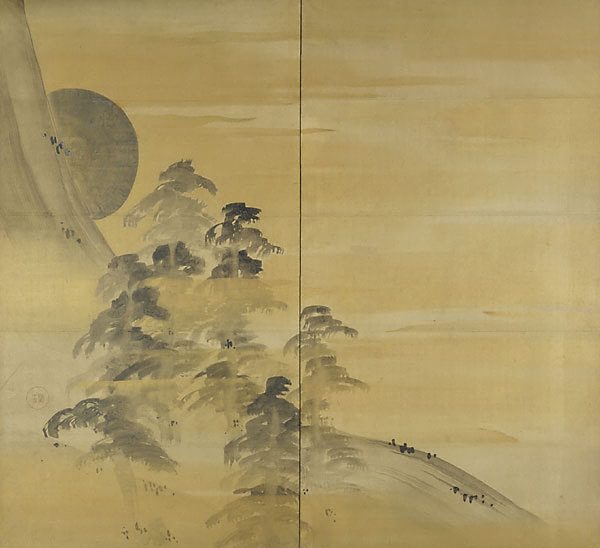
Nothing could be more telling of the unique Japanese aesthetic than the mysterious poetry of this screen, as abbreviated in its delivery as it is fulfilling in its effect. Watanabe Shikô belonged to the very Japanese Rinpa school of painting, named after Ogata Kôrin (1658-1716) with whom Shikô studied. The school's origins go back to the late sixteenth and early seventeenth centuries, when the artists Tawaraya Sôtatsu and Hon'ami Kôetsu sought to re-establish the brilliant style and unique sensitivity of the aristocratic art of Japan's 'golden age', the Heian period (794-1184). Hallmarks of the Rinpa school are a rich but refined decorative effect, achieved through an impeccable compositional balance; a fondness for metallic washes and inlays; and an emphasis on nature. Here the full autumn moon peers out from the mountain-side, and pine trees are defined by a few sparse but expressive black ink strokes.
Art Gallery Handbook, 1999. pg. 278.
-
Places
Where the work was made
Japan
-
Exhibition history
Shown in 2 exhibitions
Great gifts, great patrons, Art Gallery of New South Wales, Sydney, 17 Aug 1994–19 Oct 1994
The art of Japanese screen painting, Art Gallery of New South Wales, Sydney, 06 Nov 2004–06 Feb 2005
-
Bibliography
Referenced in 5 publications
-
Edmund Capon, Orientations, 'Asian Collections in the Art Gallery of New South Wales', pg. 76-79, Hong Kong, Sep 2000, 77 (colour illus.). fig.3
-
James Ashley Franklin and Antony Wheeler (Musicians), Moon road to dawn: an encounter of Chinese and Japanese traditional music, Arizona, 1999, front cover (colour illus.). this is the cover of an audio-CD of traditional Chinese and Japanese music
-
Bruce James, Art Gallery of New South Wales handbook, 'Asian Collection: East Asia', pg. 246-287, Sydney, 1999, 278 (colour illus.).
-
Jackie Menzies, AGNSW Collections, 'Asian Art - India, South-East Asia, China, Tibet, Korea, Japan', pg. 173-228, Sydney, 1994, 219 (colour illus.).
-
Jackie Menzies (Editor), The Asian Collections Art Gallery of New South Wales, Sydney, 2003, 11 (colour illus.).
-