Title
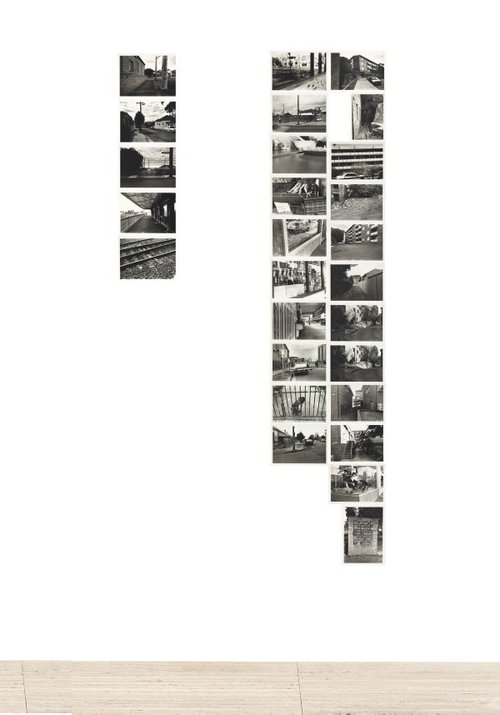
Wonderlust
1996-1998
Artist
-
Details
- Date
- 1996-1998
- Media category
- Installation
- Materials used
- eleven banana skins, engraved with the opening pages of Len Deighton's 'Spy Line'. London: Hutchinson, 1989 (an espionage story set in post-wall Berlin).
- Dimensions
- installation dimensions variable
- Credit
- Gift of the artist 2003
- Location
- Not on display
- Accession number
- 97.2003.1.a-k
- Copyright
- © Simryn Gill
- Artist information
-
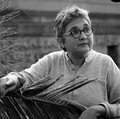 Simryn Gill
Works in the collection
- Share
-


-
About
Gill cultivates a stance in regard to nature and culture in which she refuses to be naturalized or to be native, either as an exemplary nomadic citizen of our global village or as an authentic South East Asian post-colonial 'voice'. While Gill frequently uses autobiographical references in her practice, she also refuses to equate her own experience with the meaning produced by her work. Inevitably questions of 'speaking as' or 'speaking for' proliferate around her work. Gill's deliberately shifty stance and the tensions it produces open up the ways in which her work can be regarded. Rather than being overtly critical of a colonial past, it is "about the many confusions, pleasures and contradictions of being in ones particular present" (Gill).
Gill has made a number of works in which natural materials become clothing items. Earlier works, such as her richly evocative and aromatic mango skin cloaks and chilli headdresses, made explicit reference to trade and exchange. Other clothing and adornment items, including a banana skin wig and this coconut husk suit, are a humourous look at contemporary attitudes to race, identity and place. The use of natural products also featured in 'A small town at the turn of the century', a photographic portrait of the peoples of a particular place in which their faces were obscured by fruit masks made from local produce.
This coconut bark suit was tailor made and fitted for Singaporean art critic and writer Lee Weng Choy. Gill requested Lee to present a lecture on art theory (with a topic of his choice) whilst wearing the suit, but unfortunately this was not possible as the bark stiffened before arrangements were made. The most well known image of this suit is of Lee wearing it on the Singaporean subway system, and has featured in many publications since. Lee's shoes are attached to the pair of coconuts which also form part of this work. The coconut is a ubiquitous tree of the tropics, the seeds of which travel great distances on ocean currents, taking root where they wash up. The coconut has also become a slang and often derogatory term indicating brown skin and white attitudes, of tension between local and international cultures and allegiances.
-
Exhibition history
Shown in 4 exhibitions
Wonderlust, Artspace, Woolloomooloo, 1996–1996
Above and beyond: Austral/Asian interactions, Australian Centre for Contemporary Art, South Bank, 02 Aug 1996–15 Sep 1996
Above and beyond: Austral/Asian interactions, Institute of Modern Art, Fortitude Valley, Oct 1996–Oct 1996
Above and beyond: Austral/Asian interactions, 24HR Art - Northern Territory Centre for Contemporary Art, Darwin, 1997–1997
Above and beyond: Austral/Asian interactions, Contemporary Art Centre of South Australia, South Australia, 1997–1997
Above and beyond: Austral/Asian interactions, Canberra Contemporary Art Space, Canberra, Jul 1997–Aug 1997
Simryn Gill, Bluecoat Gallery, Liverpool, , 1999–1999
Simryn Gill, Ikon Gallery, Birmingham, Birmingham, 2000–2000
-
Bibliography
Referenced in 7 publications
-
Lee Weng Choy, Art Asia Pacific, 'Local Coconuts: Simryn Gill and the Politics of Identity', 1997.
-
Marian Pastor Roces, Art &Text (no.56), 'Simryn Gill: Slow Release', 1997.
-
The Organisation for Visual Arts, Simryn Gill, London, 1999.
-
Wayne Tunnicliffe (Curator), Simryn Gill: selected works, Sydney, 2002, 8, 10 (colour illus.).
-
Claire Williamson and Michael Snelling, Above and beyond : Austral/Asian interactions, 'Australian/ Asian interactions', pg. 3-11, 1996, 7, 48. 'Fragment #5'
-
Author Unknown, Wardrobe, Adelaide, 1997.
-
Author Unknown, Wonderlust, 1996.
-