Title
Wangarra Spirit Being
1985
Artist
-
Details
- Place where the work was made
-
Central Arnhem Land
→
Northern Territory
→
Australia
- Date
- 1985
- Media category
- Sculpture
- Materials used
- ochre on carved wood
- Dimensions
- 288.5 x 24.5 x 20.0 cm
- Signature & date
Not signed. Not dated.
- Credit
- Purchased 1985
- Location
- Not on display
- Accession number
- 82.1985
- Copyright
- © Estate of England Banggala/Copyright Agency
- Artist information
-
England Banggala
Works in the collection
- Share
-


-
About
Non ceremonial figure carving representing the devil spirit called Wangarra from a jungle area a few miles from the artist's home. The spirit inhabits the An-ngiliny clan waterhole called Wangarra A-juwana. This is a dense patch of jungle with a network of creeks that is adjoined by the two large billabongs called Boporlinymarr and Birduk Mu-yerrnyjiya.
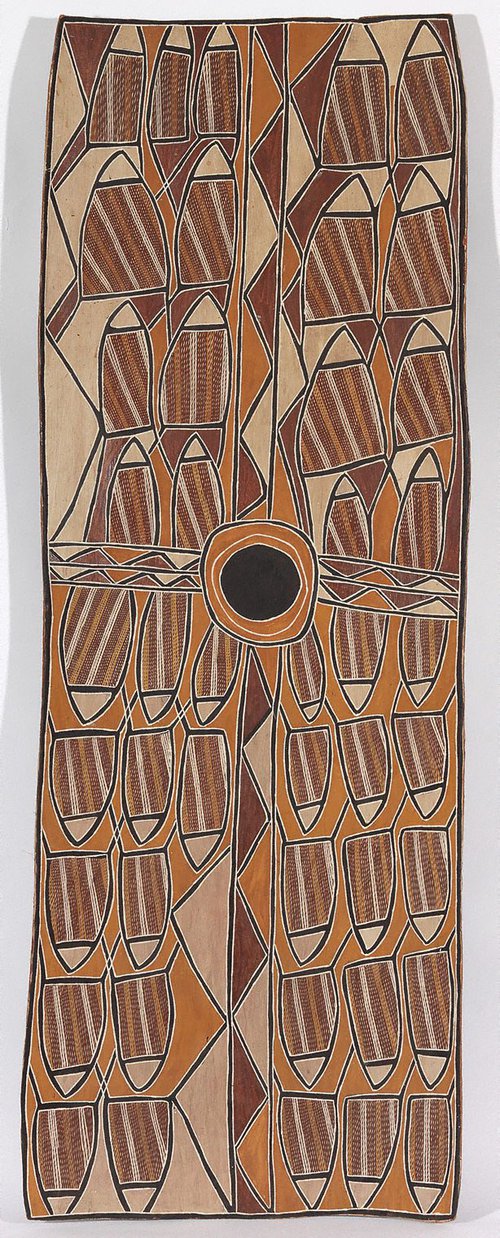
The painting depicts five wangarra figures and four rocks which lie inside the water at Wangarra A-juwana. Across the centre of the painting is a band which represents a small creek that runs through Wangarra A-juwana. Two of the wanagarra spirits share one arm; this represents the water running from the little creeks, flowing out into all corners of the patch of jungle.
On the edge of the water at Wangarra A-juwana stands a huge banyan tree. The wangarra spirits live inside this tree. at times the tree opens up, and the wangarra spirits come out and go down into the water where they lie inside the rocks. The spirits can lure and trap people inside the banyan tree, which is one reason why Wangarra A-juwana is a dangerous place for those who do not have the right authority to go there. Whan Banggala enters this place he calls out to his ancestors to identify himself as a rightful member of the An-nguliny clan, so that he and his companians are protected from the spirits that live there.
Australian Art Department, AGNSW, 2000
-
Places
Where the work was made
Central Arnhem Land
-
Exhibition history
Shown in 2 exhibitions
Aratjara: art of the first Australians, Stiftung Kunstsammlung Nordrhein-Westfalen, Germany, 23 Apr 1993–04 Jul 1993
Aratjara: art of the first Australians, Hayward Gallery, London, 23 Jul 1993–10 Oct 1993
Aratjara: art of the first Australians, Louisiana Museum of Modern Art, Denmark, 11 Feb 1994–23 May 1994
Biennale of Sydney 2000, Museum of Contemporary Art, Australia, 26 May 2000–30 Jul 2000
-
Bibliography
Referenced in 3 publications
-
Ewen McDonald (Editor), Biennale of Sydney 2000, Sydney, 2000, 191 (colour illus.). no catalogue numbers
-
Hetti Perkins and Ken Watson, A material thing - objects from the collection, Sydney, 1999, 6.
-
Paul S.C. Tacon, Aratjara: art of the first Australians, 'The Power of the Image among the Past and Present Peoples of Arnhem Land', pg. 127-196, Dusseldorf, 1993, 157 (colour illus.), 334. cat.no. 27
-