Title
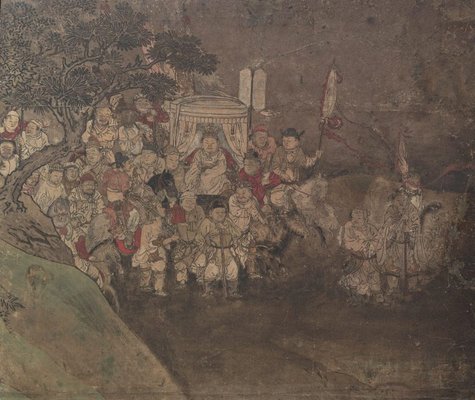
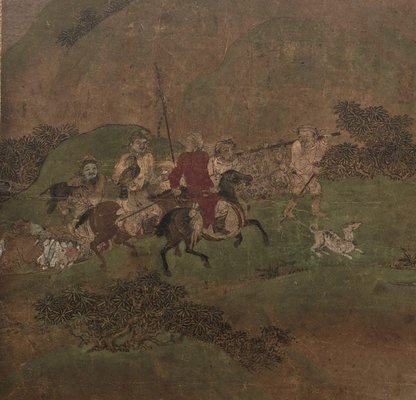
Tartars hunting
circa 1550
Artists
Unknown Artist

-
Details
- Other Title
- Hunting scene before the Emperor of Mongolia
- Place where the work was made
-
Japan
- Period
- Muromachi (Ashikaga) period 1392 - 1573 → Japan
- Date
- circa 1550
- Media categories
- Screen , Painting
- Materials used
- single six-panel screen; colours on paper
- Dimensions
- 141.0 x 337.7 cm image; 154 x 348.6 cm screen
- Signature & date
Not signed. Not dated.
- Credit
- Gift of Paul Haefliger 1982
- Location
- Not on display
- Accession number
- 220.1982
- Copyright
- Share
-


-
About
Japan's relationship with Chinese culture has always been a complex one of absorption, transmutation or rejection. The tensions inherent in the Japanese synthesis of China are evident in this rare and important screen. It illustrates a Chinese subject and technique, and a Japanese sense of space and empathy with nature. The scene, realised with orthodox Chinese brushwork, is a depiction of Tartars hunting, a popular Chinese subject from the thirteenth century. The Chinese both admired and feared the hunting and military skills of the fierce nomadic Tartars with whom they were frequently at war. The eye is drawn to the dense mass of figures in the upper left, typical of such scenes. This group is undoubtedly a representation of the infamous incident when a Hiongnu Tartar chieftain captured a beautiful Chinese lady and carried her off to Mongolia in 195 CE. She bore him two children and was deeply happy. When her family reclaimed her, forcing her from her husband and children, she composed poignant verses which have since become Chinese classics.
'Asian Art', AGNSW Collections, 1994, pg. 214.
-
Places
Where the work was made
Japan
-
Bibliography
Referenced in 4 publications
-
Christine France, Art and Australia (Vol. 37, No. 1), 'A Matter of Taste', pg. 75 - 81., Sydney, 1999, 78 (colour illus.).
-
Robert Haines (Editor), Japanese screens and lacquer, Sydney, Dec 1970, unpaginated (illus.). cat no. 1
-
Jackie Menzies, AGNSW Collections, 'Asian Art - India, South-East Asia, China, Tibet, Korea, Japan', pg. 173-228, Sydney, 1994, 214 (colour illus.).
-
Jackie Menzies (Editor), The Asian Collections Art Gallery of New South Wales, 'The World of Samurai Culture', Sydney, 2003, 212 (colour illus.).
-