
-
Details
- Other Title
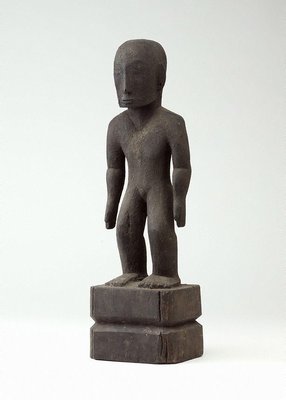
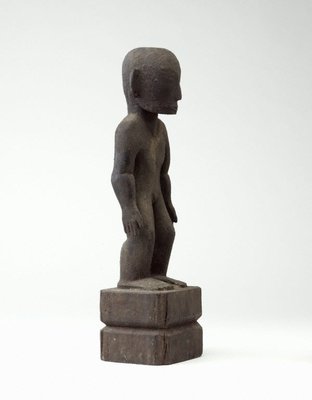
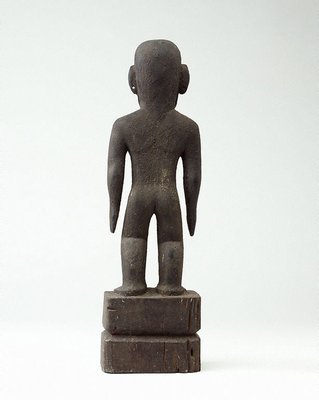
- Standing 'bulul' Rice God figure
- Place where the work was made
-
Ifugao
→
Central Cordillera
→
Luzon
→
Philippines
- Cultural origin
- Ifugao
- Date
- 20th century
- Media category
- Sculpture
- Materials used
- wood
- Dimensions
- 55.5 cm
- Credit
- Gift of Dr John Yu and Dr George Soutter 2005
- Location
- Not on display
- Accession number
- 219.2005
- Copyright
- Artist information
-
Ifugao
Works in the collection
- Share
-


-
About
The mountainous region of Central Cordillera in northern Luzon is home to a large number of indigenous communities. Their fierce self-determination and geographic isolation provided relative protection from the cultural influences of Spanish colonisation. However, their art did not remain unchanged. Communities retained forms which were useful and meaningful, abandoned others and created new forms to meet new purposes – a tradition that has continued into 21st century.
In Central Cordillera art is part of everyday life and is intrinsically linked to community and spiritual wellbeing. Many villages are built around a central stone platform where social and spiritual rites are performed. These include the worship of deities and ancestors and the consecration of sculptural figures.
The carving of ancestral and religious figures, while today most prevalent among Ifugao men, was previously a practise shared by all communities of the Central Cordilleran mountain range. Textiles, on the other hand, are woven exclusively by women using backstrap looms. There has been a long and active trade in locally woven products, so many communities share techniques and an appreciation for similar motifs and colour schemes.
Bulul are the most numerous and best known of Ifugao figurative sculptures and usually take the form of either a standing or seated figure. They are carved from a single piece of wood and generally exhibit a stylised and geometric rendering of the human body. The standing figures either feature their hands hanging beside the body or resting on their knees, while the arms of the seated figures are typically folded. They are often made in male and female pairs, but this figure appears to be androgynous.
Bulul are very important in Ifugao society, where rice is the staple crop, and they are frequently placed in rice fields and granaries as guardians. Before taking up their function as guardians, the sculptures are ritually consecrated by coating the figure with pig or chicken blood, which can leave them with a darkened and mottled patina.
-
Exhibition history
Shown in 2 exhibitions
Passion and procession: art of the Philippines, Art Gallery of New South Wales, Sydney, 24 Jun 2017–07 Jan 2018
Walking with gods, Art Gallery of New South Wales, Sydney, 01 Jun 2019–05 Jan 2020
-
Provenance
John Yu, 1970s-2005, Sydney/New South Wales/Australia, purchased mid-1970s from an antique shop in Mabini St, Manila, Philippines. Donated to the Art Gallery of New South Wales, Sydney, 2005.

