Title
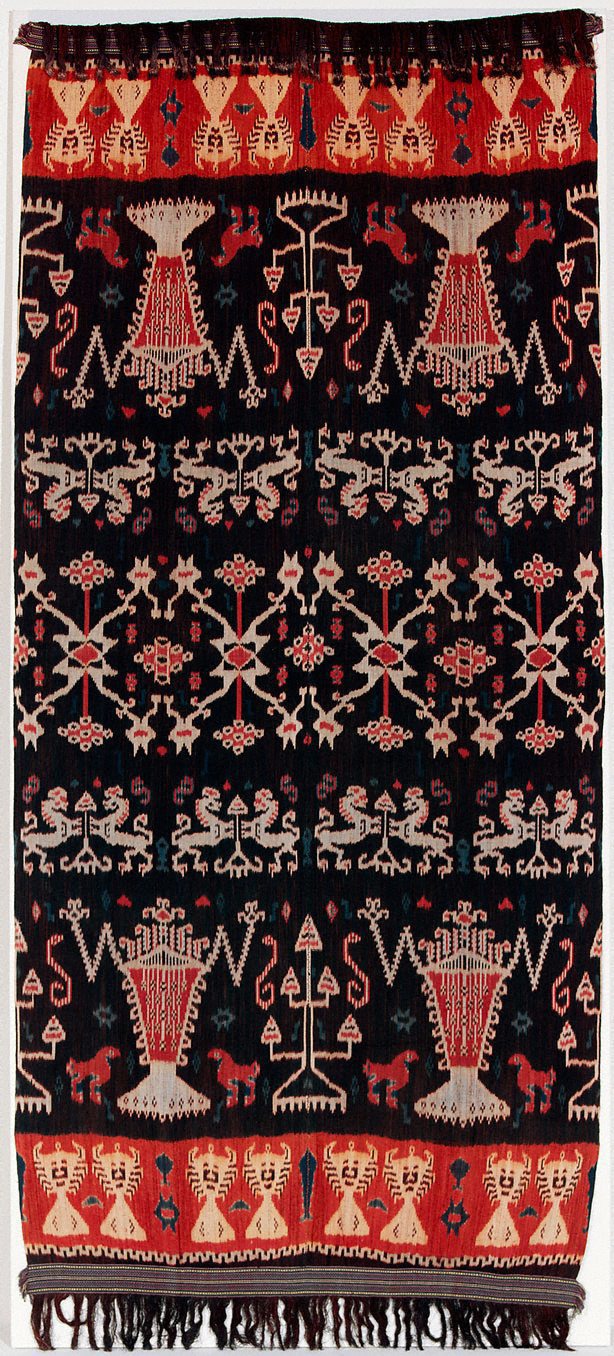
Man's shawl or mantle (hinggi) with crayfish and 'coat of arms' design
circa 1970
Artists
Unknown Artist
-
Details
- Place where the work was made
-
East Sumba
→
Sumba
→
East Nusa Tenggara
→
Lesser Sunda Islands
→
Indonesia
- Date
- circa 1970
- Media category
- Textile
- Materials used
- cotton and natural dyes; warp ikat with supplementary weft patterning and braided ends
- Dimensions
- 114.2 x 274.0 cm
- Credit
- Gift of Dr John Yu and Dr George Soutter 2003
- Location
- Not on display
- Accession number
- 182.2003
- Copyright
- Share
-


-
About
In Sumba, as in many parts of Indonesia, textiles represent one of the most significant art forms. The most fully developed textile tradition existed in the east of the island where textiles were made to fulfil ritual, ceremonial and everyday functions. One of the most distinctive Sumbanese cloths is the hinggi (man's shawl), a very large cloth decorated with bold designs in a warp ikat. Usually a pair is made; one is worn as a sarong, while the other is folded over the shoulder as a long scarf or used as a shawl.
Hinggi are distinguished by their bold figurative designs of frontally standing figures, ‘skull trees’, and other more enigmatic figurative motifs. This example is decorated with various motifs including a crayfish-like animal. It is designed in accordance with the idea that a person is able to acquire special powers and qualities of the images depicted on the cloth. The animals are rendered in large scale, a stylistic tendency which suggests that this textile dates to the mid-1970's.
Asian Art Department, AGNSW, April 2016
-
Exhibition history
Shown in 2 exhibitions
Symbols and Ceremonies: Indonesian Textile Traditions, Art Gallery of New South Wales, Sydney, 13 Apr 2006–28 May 2006
In one drop of water, Art Gallery of New South Wales, Sydney, 15 Jun 2019–21 Feb 2021